
Table of Contents
- What Is Super Mario Bros. Wonder?
- The Flower Kingdom: A New Setting for Mario
- Wonder Flowers and Wonder Effects Explained
- New Power-Ups: Elephant Fruit, Bubble Flower, and Drill Mushroom
- The Badges System
- Playable Characters
- Multiplayer, Standees, and Online Play
- Level Design Philosophy and World Structure
- Platforms, Editions, and Where to Play
- Critical Reception and Awards
- Sales Performance
- Tips for New Players
- Who Is Super Mario Bros. Wonder For?
- FAQ
- Conclusion
- External Authority Sources
For nearly four decades, side-scrolling Mario games followed a familiar rhythm: run right, jump on Goombas, grab a Mushroom, reach the flagpole. Super Mario Bros. Wonder, released worldwide for Nintendo Switch on October 20, 2023, is the game that finally broke that rhythm on purpose. Developed and published by Nintendo, it dropped the long-running New Super Mario Bros. visual style in favor of a hand-crafted, storybook-like art direction, then built an entire mechanic around the idea that a Mario level should never behave the same way twice. The result was a genuine surprise in a franchise known for consistency rather than reinvention, and it landed with critics and players as one of the best-reviewed platformers in years. This guide covers everything a player, parent, or curious fan needs to know: the Flower Kingdom setting, the Wonder Flower and Wonder Effect system that reshapes courses in real time, new power-ups like the Elephant Fruit and Bubble Flower, the Badges system that lets players customize how they move, the full roster of playable characters, how local and online multiplayer actually work, and what critics, sales figures, and awards say about where the game stands in Mario’s history.
What Is Super Mario Bros. Wonder?
Super Mario Bros. Wonder is a 2D side-scrolling platformer developed by Nintendo EPD and published by Nintendo for the Nintendo Switch. It is the first mainline side-scrolling Mario game since 2012’s New Super Mario Bros. U to abandon the New Super Mario Bros. subtitle and visual template, and the first traditional 2D Mario title in over a decade to introduce a genuinely new setting rather than the Mushroom Kingdom. Direction on the project was led by Shiro Mouri, who has cited the original 1985 Super Mario Bros. as a key inspiration, while veteran Nintendo producer Takashi Tezuka oversaw the project with the explicit goal of reinventing the 2D Mario formula rather than iterating on it again. Development reportedly began in 2019.
The core pitch of the game is simple to state but ambitious to execute: every course contains a hidden Wonder Flower, and touching it triggers a Wonder Effect that transforms the level’s rules, geometry, or goals for a stretch of gameplay. One course might turn Mario into a giant spiked ball rolling through a course of dominoes; another might have pipes come alive and start walking. No two Wonder Effects work the same way, and that unpredictability is the game’s entire identity. Around that central hook, Nintendo built new power-ups, a badge-based customization system, an expanded roster of playable characters, and a soft-online multiplayer mode that lets players see friends and strangers moving through the same courses in real time.
Super Mario Bros. Wonder was priced as a full retail release at launch and was later joined by a Nintendo Switch 2 Edition, a paid upgrade for the newer console that adds performance improvements and additional content, discussed later in this guide.
The Flower Kingdom: A New Setting for Mario
Rather than sending Mario and friends back to the Mushroom Kingdom to save Princess Peach from Bowser yet again, Super Mario Bros. Wonder opens with an invitation. Prince Florian, ruler of the newly introduced Flower Kingdom, invites Mario, Luigi, Peach, Daisy, and the rest of the group to visit his land, described in official materials as a not-so-distant kingdom just beyond the borders of the Mushroom Kingdom. The premise gives Nintendo’s artists a clean excuse to build a completely new aesthetic and cast of local characters without discarding the classic Mario cast players already know.
The Flower Kingdom’s defining local resource is a strange and powerful bloom called the Wonder Flower, which the kingdom’s flora and fauna have learned to live alongside, and occasionally fear. True to Mario tradition, Bowser wastes no time crashing the visit: he seizes control of Florian’s castle and fuses himself directly into its structure, transforming it into a towering, snarling Bowser Castle that looms over the kingdom for the rest of the adventure. That castle sits at the center of the game’s map, ringed by the surrounding regions the player explores.
The kingdom is populated by a new species of small, expressive creatures called Poplins, who run shops, hand out sidequests, and populate the game’s hub areas. Another recurring fixture are the Talking Flowers, sentient blossoms embedded throughout many courses that comment on the player’s actions as they happen. According to producer Takashi Tezuka, the Talking Flowers grew out of an earlier, more ambitious idea for dynamic voice commentary that reacted to whatever the player was doing; when that system proved too complex to implement well, the team adapted the concept into a character that could be placed in specific spots in a level, which became the Talking Flower players now hear cheering, warning, and joking throughout the adventure.
Geographically, the Flower Kingdom is organized around a central hub area called Petal Isles, which connects to six main regions: Pipe-Rock Plateau, Fluff-Puff Peaks, Shining Falls, Sunbaked Desert, Fungi Mines, and Deep Magma Bog. Each region has its own visual identity and recurring gimmicks. Sunbaked Desert, for example, is built around sweeping white sand dunes and a large palace housing multiple courses, while Fungi Mines wraps its levels in gloomy woods, swamps, and fog-obscured ruins. Petal Isles itself offers a mix of beaches and aquatic caves and serves as the connective tissue linking the outer regions back to Bowser’s castle at the map’s center.
Wonder Flowers and Wonder Effects Explained
The Wonder Flower is the single mechanic that defines Super Mario Bros. Wonder as a game, and it is worth understanding in detail because nearly everything else in the design revolves around it.
Every standard course in the game hides at least one Wonder Flower somewhere in its layout, sometimes in plain sight, sometimes tucked behind a secret path. According to Nintendo’s own gameplay materials, Wonder Flowers draw on the Flower Kingdom’s mysterious ambient power and release it the moment they bloom. When Mario or another character touches one, the course immediately triggers a Wonder Effect: a dramatic, often bizarre transformation of the level’s rules, geometry, camera, goals, or all of the above, for a limited stretch of gameplay.
No two Wonder Effects behave the same way, and that is deliberate. In one course, touching the Wonder Flower might send a line of pipes to life, causing them to crawl across the screen and forcing the player to keep pace as the entire stage becomes mobile. In another, Mario might transform into a giant, spike-covered ball that rolls automatically through a Bowser’s Castle-style domino run, with the player steering left and right to avoid falling off the edge. Some Wonder Effects change the camera angle entirely, switching a normal side-scrolling course into an overhead or reverse perspective. Others turn enemies into unexpected allies, flood a stage with collectible items, or task the player with a musical rhythm challenge instead of standard platforming. The unifying idea is unpredictability: Nintendo’s design team built dozens of these sequences specifically so that experienced Mario players could not lean on pattern recognition from prior games.
Wonder Effects are not permanent changes to the level. Each one runs for a set duration or until the player accomplishes a specific objective inside the altered course, at which point collecting a Wonder Seed closes out the sequence and reverts the stage back to its normal state, delivering the seed to the player’s inventory as a key collectible used to unlock further courses on the world map. Because most courses hide their Wonder Flower somewhere non-obvious, hunting for it becomes its own light exploration incentive layered on top of the core platforming.
This system is also why Super Mario Bros. Wonder resists being described in the shorthand used for prior 2D Mario entries. Earlier games in the New Super Mario Bros. series were praised for tight, well-tuned platforming built from a fairly consistent toolkit of mechanics repeated with variations. Wonder inverts that approach: the toolkit itself keeps changing from course to course, and the Wonder Flower is the trigger that makes that possible without breaking the game’s overall structure.
New Power-Ups: Elephant Fruit, Bubble Flower, and Drill Mushroom
Super Mario Bros. Wonder keeps the franchise’s classic power-ups in circulation, including the Super Mushroom, Fire Flower, and Super Star, but its marketing and level design lean heavily on three brand-new transformations introduced specifically for this game.
Elephant Fruit. Touching an Elephant Fruit turns a character into an elephant version of themselves, complete with a trunk that functions as both weapon and tool. The trunk can be swung to knock out nearby enemies, and it can store water, which the player can then spray to hydrate withered plants and reveal hidden paths that are otherwise inaccessible. The Elephant form is also physically sturdier than Mario’s base form, able to break straight through certain blocks that would otherwise require a different power-up or badge. Because the ability to interact with the environment (watering plants, smashing blocks) is baked directly into the transformation, Elephant Fruit segments are often built around light puzzle-solving rather than pure platforming reflexes.
Bubble Flower. The Bubble Flower lets a character blow bubbles that can trap enemies inside, neutralizing them without direct combat, and the same bubbles can be used as makeshift platforms: jumping off a bubble the player just blew grants an extra height boost, opening up vertical routes that would otherwise be unreachable. This dual function, offense and mobility from the same tool, makes Bubble Flower one of the more versatile power-ups in the game, especially in courses with awkward vertical gaps.
Drill Mushroom. The Drill Mushroom equips the player with a drill capable of breaking through certain hard blocks with a ground pound and burrowing directly through the terrain. While drilling, the character can safely tunnel beneath enemies rather than confronting them, and the same ability lets them drill upward into ceilings, letting them travel through solid material in either direction. It effectively turns a normally two-dimensional plane of movement into something closer to three, letting players bypass obstacles by going through the level rather than over or around it.
Alongside these three headline additions, the returning Super Mushroom, Fire Flower, and Super Star function largely as expected from decades of prior Mario titles, giving the game a mix of comfortable, familiar tools and entirely new ones. The presence of both is part of what critics repeatedly pointed to as the game’s balancing act: it introduces enough new ideas to feel fresh while keeping enough of the old toolkit intact that longtime players are never fully out of their depth.
The Badges System
Where the Wonder Flower changes what a level does to the player, the Badges system changes what the player can do to a level, and it is one of the most significant structural additions in the game. Badges are equippable passive or active abilities, and the base version of Super Mario Bros. Wonder includes 24 of them (the later Nintendo Switch 2 Edition adds 18 more, bringing the total to 42).
Badges are organized into three categories, distinguished by color:
- Action Badges (red) grant the player a new skill they can actively trigger, such as a Dolphin Kick for underwater sections, a wall jump, a crouch jump, or a parachute-style cap glide usable even by characters like Peach and Toad who don’t otherwise have gliding abilities in this game. Action Badges are activated on demand, typically by pressing a shoulder button while playing.
- Boost Badges (blue) provide passive, largely accessibility-oriented effects, such as automatically granting a Super Mushroom whenever the player takes damage or spawning helpful “? Block” style aids, making them a useful option for players who want a gentler difficulty curve without changing the core level design.
- Expert Badges (yellow) apply more powerful, higher-risk effects, including options like temporary invisibility, and are reserved for players tackling the game’s harder optional content.
Crucially, only one Badge can be equipped at a time per course, which forces meaningful choices rather than letting players stack every advantage simultaneously. A player might equip a wall-jump badge to tackle a vertically demanding course, then swap to a Boost Badge for a course built around item collection, and swap again to an Expert Badge when attempting an optional challenge stage.
Badges are earned in two main ways. Many are unlocked by completing dedicated Badge Challenge stages, short courses built specifically to test the skill the badge grants (a course built entirely around wall jumps to unlock the Wall Jump Badge, for instance). Others can simply be purchased using Flower Coins, the game’s in-course collectible currency, at Poplin-run shops scattered around the map, typically for 100 Flower Coins each. Expert Badges are the exception: all of them are earned exclusively by completing the game’s separate, considerably more difficult Expert Badge Challenge stages, which are explicitly designed for players looking for a tougher test than the main adventure provides.
Together, the Badges system gives Super Mario Bros. Wonder a light layer of build customization that 2D Mario games have historically lacked, while the one-badge-at-a-time restriction keeps that customization from undermining the game’s core difficulty curve.
Playable Characters
Super Mario Bros. Wonder features the largest roster of playable characters in a mainline Super Mario platformer. Counting each distinct color variant separately, the game offers 12 playable characters: Mario, Luigi, Princess Peach, Princess Daisy, Yellow Toad, Blue Toad, Toadette, four different colors of Yoshi (green, red, yellow, and light blue), and Nabbit.
The human and Toad-family characters, meaning Mario, Luigi, Peach, Daisy, the two colored Toads, and Toadette, all control identically. None of them carry a statistical advantage or unique built-in ability over the others; the choice between them is purely cosmetic, which matters for local co-op sessions where friends or family members want to pick a favorite character without worrying about being at a mechanical disadvantage.
Yoshi and Nabbit are the exceptions, and both function as easier, more forgiving options. The various Yoshis cannot take direct damage from most obstacles and enemies; instead of dying, they simply bump into hazards and recoil, and they retain series-standard Yoshi abilities like the Flutter Jump for extended air control and a tongue that can swallow enemies and certain items. Nabbit similarly cannot be hurt by most enemies, effectively phasing through them rather than taking damage. The tradeoff for both characters is that they are unable to use power-ups, including the new Elephant Fruit, Bubble Flower, and Drill Mushroom, which keeps them from simply being a strictly better option and instead positions them as an accessible on-ramp for younger players or anyone learning the game’s controls for the first time.
Multiplayer, Standees, and Online Play
Super Mario Bros. Wonder supports both local and online multiplayer, but the two modes work quite differently from each other, and understanding that distinction matters for anyone planning to play with friends or family.
Local co-op supports up to four players simultaneously on a single Nintendo Switch console, with each participant needing their own controller. This is a true shared-session mode: players occupy the same course at the same time, can see and bump into one another, and share the same screen and camera as they race toward the goal together. If a player is defeated during a local session, their character doesn’t simply respawn; instead, it floats around the course as a ghost, and another player can revive them by touching that ghost before a countdown runs out, keeping the whole group moving forward together rather than restarting.
Online multiplayer works on a fundamentally different model, often referred to as “Connect Online” in the game’s menus. Rather than dropping multiple players into a fully shared, physics-interactive session, online play shows other real players as translucent “ghost” figures moving through the same course in real time. You can see them jumping over the same hazards, collecting the same items, and reacting to the same Wonder Effects, but you cannot physically collide with them, break blocks together, or directly interact the way local players can. Despite that limitation, online play is not purely passive: players can still revive one another using the standee system described below, share Item Balloons that appear in-course, and take part in optional Friend Races, timed competitions to reach the Goal Pole, a Wonder Seed, or a Treasure Chest first on specific courses. A single online Co-Op room can host up to 12 players total, though only up to 4 are shown actively playing the same course together at any given moment.
Standees are a core piece of connective tissue in both modes. A Standee is a small figure representing a character that a player can place at a specific spot in a course; if another player (in local or online play) is defeated and turns into a ghost, they can revive themselves by reaching that Standee before its countdown expires, functioning as a strategically placed extra life for teammates. Standees can be earned or purchased with Flower Coins, and players can collect a growing library of them to place in tricky or hazard-heavy sections of a level as a safety net for their group.
Level Design Philosophy and World Structure
Two design principles run through Super Mario Bros. Wonder and explain why it plays so differently from the New Super Mario Bros. series that preceded it.
The first is unpredictability as a design pillar rather than an occasional twist. Traditional 2D Mario level design, going back to the original Super Mario Bros., typically introduces a mechanic early in a course, has the player practice it, then escalates the challenge before the flagpole. Wonder keeps that basic shape for the opening and closing of most courses but inserts a Wonder Flower somewhere in the middle specifically to break the pattern the player has just learned. The design team’s stated goal, reflected in interviews and gameplay presentations around launch, was to prevent the game from ever settling into a rhythm long enough for seasoned players to go on autopilot. That is why Wonder Effects range so widely, from turning enemies into number blocks to flipping the entire camera perspective to transforming Mario into an object with completely different physics for the remainder of a stage.
The second pillar is a return to hand-authored, illustration-style visual presentation. Nintendo moved away from the more uniform, semi-realistic look of the New Super Mario Bros. games in favor of exaggerated, expressive character animation (Mario’s face now visibly registers surprise, effort, and panic in ways prior HD Mario games never rendered) paired with painterly, storybook-influenced backgrounds for each region. This wasn’t purely cosmetic: the more expressive character models were built specifically to sell the comedic and dramatic beats triggered by Wonder Effects, since a joke or a moment of chaos lands harder when the characters’ faces can visibly react to it.
Structurally, the game organizes its roughly one hundred courses across the six main regions plus the Petal Isles hub, with each region gating access to the next through story-relevant checkpoints, typically a boss encounter tied to Bowser’s now-fused castle-body extending its influence into new territory. Special courses, Badge Challenges, and Expert Badge Challenges sit alongside the main path as optional content for players chasing full completion, giving the game a difficulty range that stretches from accessible family fare (helped along by Yoshi, Nabbit, and Boost Badges) to genuinely demanding platforming for series veterans.
Platforms, Editions, and Where to Play
Super Mario Bros. Wonder launched exclusively for the Nintendo Switch on October 20, 2023, as a physical and digital retail release, and it remains a Switch-family exclusive; there is no PC, PlayStation, or Xbox version, consistent with Nintendo’s long-standing practice of keeping mainline Mario platformers on its own hardware.
Following the release of the Nintendo Switch 2, Nintendo announced a Nintendo Switch 2 Edition of the game. This version, officially titled Super Mario Bros. Wonder – Nintendo Switch 2 Edition + Meetup in Bellabel Park, upgrades the technical presentation with support for 4K resolution while docked, higher and more stable frame rates (up to 60 frames per second), and shorter loading times compared to the original Switch release. Beyond performance, the Switch 2 Edition adds new content, most notably a new area called Bellabel Park, along with new multiplayer co-op and competitive modes and the addition of previously non-playable or absent characters and elements, including Rosalina and Co-Star Luma, the Koopalings, Baby Yoshis, and members of the Toad Brigade. Players who already own the original Nintendo Switch version of Super Mario Bros. Wonder can purchase a digital upgrade pack through the Nintendo eShop to access the Switch 2 Edition’s enhancements and new content without buying the game a second time at full price.
For anyone deciding which version to get, the practical takeaway is straightforward: the original Nintendo Switch release remains a complete, fully-featured game on its own, while the Switch 2 Edition is the version to choose for players who own or plan to own a Nintendo Switch 2 and want the best available performance along with the extra content built specifically for that hardware.
Critical Reception and Awards
Super Mario Bros. Wonder was received as one of the best-reviewed games of 2023 and one of the strongest entries in the 2D Mario catalog. On Metacritic, the game holds an aggregate score of 93 based on around 80 professional critic reviews, with the overwhelming majority scoring it 80 or above and several outlets awarding it a perfect 100. Critics consistently pointed to the Wonder Effect system as the game’s standout achievement, praising it for making a nearly forty-year-old genre feel unpredictable again, while also highlighting the expressive new art style, the depth added by the Badges system, and the accessibility offered by characters like Yoshi and Nabbit alongside the Boost Badges. CGMagazine, among other outlets, went as far as calling it the best 2D Mario game ever made, a sentiment echoed broadly across the review cycle.
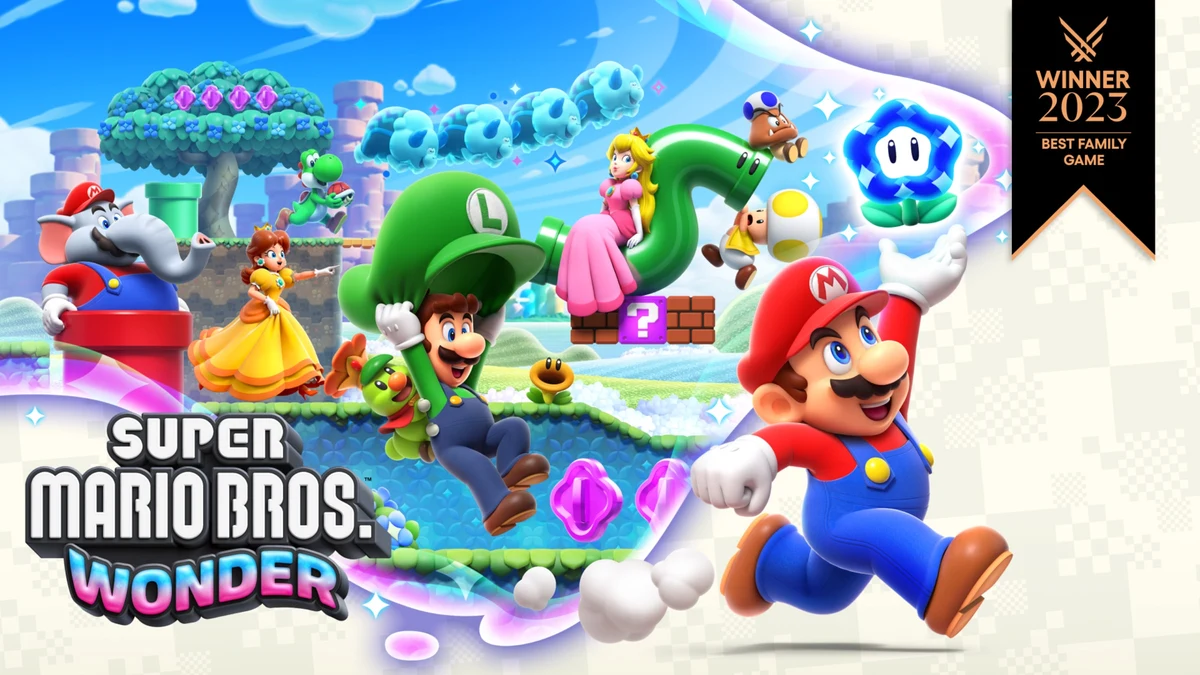
The game’s reception translated into industry recognition as well. At The Game Awards 2023, Super Mario Bros. Wonder won Best Family Game, beating out nominees including Disney Illusion Island, Sonic Superstars, Party Animals, and Pikmin 4. That award, alongside its critical scores, cemented the game’s position as not just a strong platformer on its own terms but a high point for the mainline Mario series specifically.
Sales Performance
Commercially, Super Mario Bros. Wonder was an immediate success. According to Nintendo’s own financial reporting, the game sold nearly 12 million units, specifically 11.96 million copies, in the roughly ten weeks between its October 20, 2023 launch and the end of December 2023, the closing date of Nintendo’s fiscal third quarter. That pace of sales quickly surpassed the lifetime totals of several other major first-party Switch titles from the same console generation, including Splatoon 3, and put it on a trajectory to challenge some of Nintendo’s best-selling Switch software. In Japan specifically, Famitsu’s sales chart data showed Super Mario Bros. Wonder as the best-selling game in the country for the month of its release. Given Nintendo Switch’s total lifetime hardware install base, which had surpassed 139 million units by early 2024, Super Mario Bros. Wonder’s launch performance reflected both strong critical buzz and the built-in audience that any mainline Mario platformer commands.
Tips for New Players
Whether you are picking up Super Mario Bros. Wonder for the first time or coming back after finishing the main story, a few practical pointers make the experience smoother.
Explore before rushing to the flagpole. Because Wonder Flowers and their triggered Wonder Effects are often placed off the most obvious path, resisting the urge to sprint straight to the goal pays off. Take side routes, check pipes, and look in less obvious corners of a course; that is usually where the surprises live.
Don’t ignore Badges. New players sometimes treat Badges as an optional side system, but equipping the right one for a given course, a wall jump badge for a vertically dense stage, a Boost Badge for a punishing gauntlet, can meaningfully change how approachable a level feels. Since only one Badge can be active at a time, it’s worth swapping deliberately rather than leaving the same badge equipped for the entire game.
Use Yoshi or Nabbit if you’re playing with less experienced players. Both characters cannot be hurt by most enemies and obstacles, which makes them a strong choice for younger players, newcomers to platformers, or anyone who wants to focus on exploring rather than surviving. The tradeoff, no power-ups, is a fair one for the added safety margin.
Place Standees strategically in multiplayer. Whether playing locally or online, dropping a Standee near a dangerous jump or hazard-heavy stretch gives your group, or strangers playing alongside you online, a safety net to revive from if things go wrong.
Farm Flower Coins for Badges. Since several Badges are purchasable outright from Poplin Shops for 100 Flower Coins, keeping an eye out for Flower Coins scattered through courses (they’re generally easier to find than Wonder Flowers) will let you unlock useful Badges faster instead of relying purely on Badge Challenge completions.
Try Expert Badge Challenges once you’re comfortable with the core game. These optional stages are built specifically for players who want a harder test than the main adventure offers, and they are the only way to earn Expert Badges, so they double as both a challenge and a reward.
Who Is Super Mario Bros. Wonder For?
Super Mario Bros. Wonder is built to work across a wide range of players and situations, which is a big part of why it resonated so broadly. Families with young children benefit from the Yoshi and Nabbit characters and the Boost Badges, both of which lower the game’s difficulty without altering the core level content everyone else is playing. Longtime Mario fans get a genuinely new setting, new power-ups, and a level design philosophy explicitly built to avoid the sense of repetition that had crept into the New Super Mario Bros. series. Players who enjoy local co-op get a four-player mode built around genuine, shared-screen cooperative play with a forgiving ghost-revival system, while solo players and completionists have Expert Badge Challenges, hidden Wonder Flowers, and full-map exploration to chase. The one group it isn’t built for is anyone looking to play outside the Nintendo Switch ecosystem, since the game remains a Switch-family exclusive with no plans for release on other platforms.
FAQ
What platform is Super Mario Bros. Wonder available on? Super Mario Bros. Wonder is available exclusively on Nintendo Switch, having launched on October 20, 2023. A Nintendo Switch 2 Edition, which adds performance upgrades and new content including the Bellabel Park area, is also available, either as a standalone purchase or as a digital upgrade pack for existing owners of the original Switch version.
How many players can play Super Mario Bros. Wonder at once? Local co-op supports up to four players on a single console, each with their own controller, sharing the same screen and interacting directly with one another. Online play uses a different “ghost” system where you can see and be revived by other real players in real time without directly colliding with them, and an online Co-Op room can host up to 12 players total, though only four appear active on a course at once.
What is a Wonder Flower and what does it do? A Wonder Flower is a special item hidden in nearly every course. Touching it triggers a Wonder Effect, a dramatic, temporary transformation of the level’s rules, geometry, or camera that lasts until the player collects a Wonder Seed, which then reverts the course back to normal and rewards the player with the seed as a collectible used to progress on the world map.
What are the new power-ups in Super Mario Bros. Wonder? The three new power-ups introduced in this game are the Elephant Fruit, which turns a character into an elephant able to swing its trunk, store and spray water, and break through blocks; the Bubble Flower, which lets players blow bubbles to trap enemies and bounce off them for extra height; and the Drill Mushroom, which grants a drill for tunneling through the ground and ceilings and executing damaging ground pounds.
Is Super Mario Bros. Wonder good for beginners or young children? Yes. The Yoshi and Nabbit characters cannot take damage from most enemies and hazards, making them well-suited to younger or less experienced players, and the Boost Badges category offers passive assistance, such as automatic Super Mushroom drops, that further lowers the difficulty without changing the underlying level design everyone else experiences.
Did Super Mario Bros. Wonder win any awards? Yes. Super Mario Bros. Wonder won Best Family Game at The Game Awards 2023, beating nominees including Disney Illusion Island, Sonic Superstars, Party Animals, and Pikmin 4. It also received widespread critical acclaim, holding a Metacritic score of 93 based on roughly 80 professional reviews.
Conclusion
Super Mario Bros. Wonder succeeds at something that sounds simple but is genuinely difficult for a nearly forty-year-old franchise to pull off: it makes a familiar genre feel unfamiliar again, on purpose, without sacrificing what made that genre work in the first place. The Wonder Flower and its Wonder Effects are the clearest expression of that goal, turning every course into a small gamble on what might happen next, while the Elephant Fruit, Bubble Flower, and Drill Mushroom give players new tools to solve the problems those transformations create. The Badges system adds a light but meaningful layer of customization, the expanded twelve-character roster and forgiving multiplayer options widen who can comfortably play, and the Flower Kingdom itself gives the art team room to build something visually distinct from a decade of near-identical New Super Mario Bros. releases. Backed by a 93 Metacritic score, a Best Family Game win at The Game Awards, and close to 12 million units sold within its first ten weeks on sale, the numbers back up what the reviews already said at launch: this is one of the strongest 2D platformers Nintendo has ever released, and a strong case for the best entry the 2D Mario series has produced.