
Table of Contents
- What Is Pokémon?
- The Core Gameplay Loop: Catch, Battle, Trade, Progress
- Pokémon Scarlet and Violet: The Open-World Era
- The Hidden Treasure of Area Zero: The Scarlet and Violet DLC
- Pokémon Legends: Z-A: The Newest Mainline Game
- Competitive Battling Basics: Types, Natures, EVs, and IVs
- Notable Spinoffs: Pokémon GO and Legends: Arceus
- Platforms: Nintendo Switch and Switch 2
- Tips for New and Returning Players
- Who Pokémon Games Are For
- FAQ
- Conclusion
- External Authority Sources
Few franchises have managed to stay culturally relevant for three decades while still selling tens of millions of copies of a single release. Pokémon has. Since Pocket Monsters Red and Green launched in Japan in February 1996, the series has grown into the highest-grossing media franchise in history, with lifetime revenue estimated at more than $150 billion once video games, trading cards, anime, and merchandise are counted. That scale can make the franchise feel intimidating to newcomers, and confusing to lapsed players trying to figure out where things stand after Pokémon Scarlet and Violet reshaped the mainline formula and Pokémon Legends: Z-A pushed battling into real time for the first time. This guide is built for both audiences. It walks through what the franchise actually is, how the core gameplay loop works, what changed with the open-world Paldea games and their Hidden Treasure of Area Zero expansion, what Legends: Z-A does differently, the basics of competitive battling, the spinoffs worth knowing about, and practical advice for jumping in on Nintendo Switch or Switch 2 in 2026. Whether you played Red and Blue as a kid and want back in, or you have never caught a Pokémon and want to know where to start, everything below is current, sourced, and written to get you playing with confidence rather than guesswork.
What Is Pokémon? {#what-is-pokemon}
Pokémon is a Japanese media franchise centered on fictional creatures called Pokémon, short for “Pocket Monsters.” It began as a pair of role-playing video games, Pocket Monsters Red and Green, created by Satoshi Tajiri and designed with artist Ken Sugimori, and developed by the studio Game Freak for Nintendo’s original Game Boy. Tajiri’s inspiration reportedly traced back to his childhood hobby of collecting insects, reimagined as a game about capturing, training, and trading creatures with friends over a link cable. That trading mechanic was the franchise’s founding insight: no single copy of the game contained every creature, so players needed each other to complete their in-game encyclopedia, the Pokédex.
The games were an immediate hit in Japan and, after localization, became a global phenomenon by the late 1990s alongside the anime series, the Pokémon Trading Card Game, and a wave of merchandise. Today the franchise is managed by The Pokémon Company, a joint venture formed by Game Freak, Nintendo, and Creatures Inc. specifically to oversee licensing, the trading card game, and cross-media coordination, while Game Freak continues to develop the mainline video games and Nintendo publishes them worldwide.
“Pokémon” is also shorthand for the games themselves in everyday conversation, and it is worth distinguishing the different tiers of the franchise before going further:
- Mainline RPGs: The core numbered generations, from Red and Blue through Scarlet and Violet and now Legends: Z-A. These are turn-based (or, as of Legends: Z-A, real-time) role-playing games built around exploring a region, catching Pokémon, and building a team.
- Spinoff games: Titles like Pokémon GO, the Mystery Dungeon series, and Pokémon Legends: Arceus, which experiment with different genres and mechanics outside the traditional formula.
- Adjacent media: The long-running anime, the Pokémon Trading Card Game, and films, which this guide touches on only briefly since the focus here is the video games.
After thirty years and over a hundred officially released species added generation by generation, the roster now includes more than 1,000 different Pokémon, each with a defined type, stats, and abilities that determine how it performs in battle.
The Core Gameplay Loop: Catch, Battle, Trade, Progress {#core-gameplay-loop}
Every mainline Pokémon game, regardless of generation or region, is built on the same four interlocking systems. Understanding this loop is the fastest way to understand why the series has remained popular for so long, and why Scarlet and Violet’s open-world redesign was such a significant departure.
Catching. Players explore the overworld, encounter wild Pokémon, and can weaken them in battle before throwing a Poké Ball to capture them. Capture is probabilistic: factors like the target’s remaining HP, status conditions (such as being asleep or paralyzed), and the type of Poké Ball used all affect the odds. Since the newer Legends-style games, players can also throw balls directly at wild Pokémon in the field without initiating a full battle first, which speeds up exploration considerably.
Battling. Traditionally turn-based, battles pit a player’s Pokémon against a wild Pokémon or another trainer’s Pokémon. Each Pokémon knows up to four moves, and success hinges on type matchups, stats, and strategy. Trainer battles are the backbone of progression: Gym Leaders, rivals, and the Elite Four all gate the story behind battles the player must win. Legends: Z-A broke with this format by introducing real-time combat, discussed in detail below.
Trading. Because certain Pokémon in every generation are exclusive to one game version (a deliberate design choice going back to the original Red and Green), trading with other players has always been necessary to complete a full Pokédex. Some Pokémon will only evolve when traded, adding a further social layer. Trading today happens locally or online through each game’s Union Circle or Poké Portal-style systems.
Progressing through Gyms and the League. The traditional structure sends players through a region collecting Gym Badges by defeating Gym Leaders, each themed around a specific type, before challenging the Elite Four and a Champion to complete the “League” and become the region’s champion. Scarlet and Violet kept Gyms and a Champion as one of several paths but stopped forcing players through them in a fixed order, which is the single biggest structural change in the modern games.
This loop, catch, battle, trade, progress, has stayed remarkably stable even as the presentation around it has changed dramatically, from 2D sprites on the Game Boy to fully 3D open worlds on Switch 2.
Pokémon Scarlet and Violet: The Open-World Era {#scarlet-and-violet}
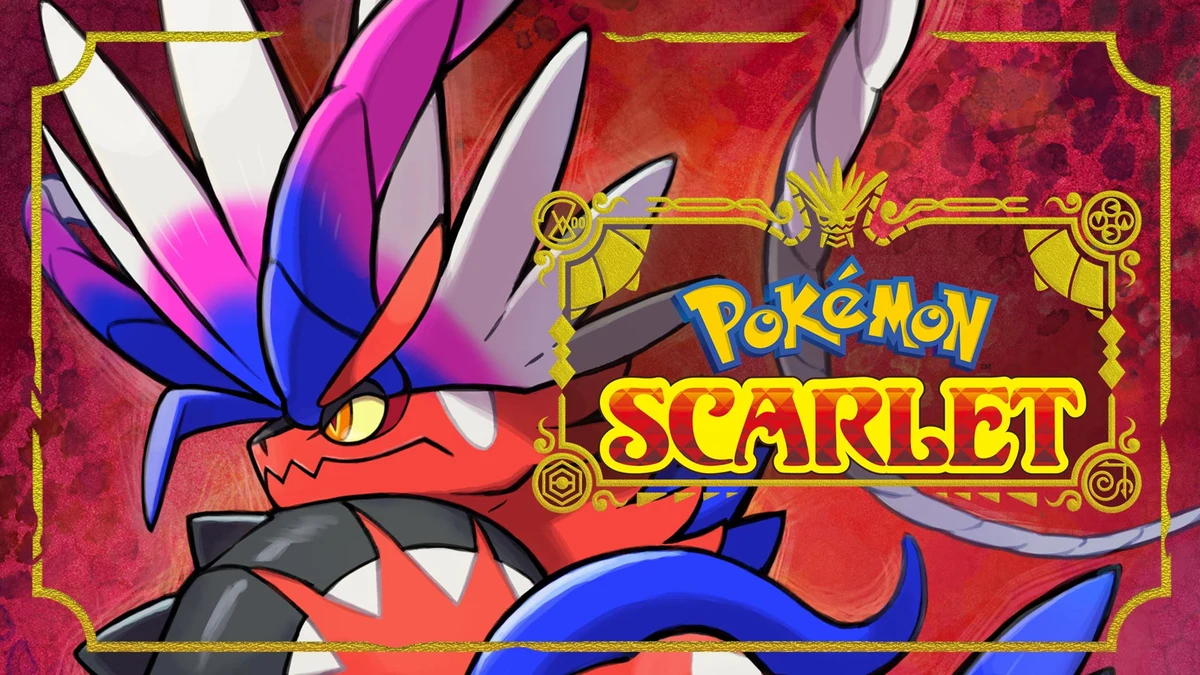
Released worldwide on November 18, 2022, for Nintendo Switch, Pokémon Scarlet and Pokémon Violet represent Generation IX and the franchise’s first true open-world mainline entry. The games are set in Paldea, a region loosely inspired by the Iberian Peninsula, featuring beaches, deserts, snow-capped mountains, and a large central crater known as Area Zero. Players attend a Pokémon-focused academy (Naranja Academy in Scarlet, Uva Academy in Violet) and are given a “treasure hunt” assignment that opens into the region’s three parallel storylines.
Rather than funneling players through Gyms in a fixed sequence, Scarlet and Violet let players tackle three independent paths in any order they choose:
- Victory Road, the traditional route of defeating the region’s eight Gym Leaders to qualify for the Elite Four and Champion title.
- Path of Legends, which sends players after towering Titan Pokémon scattered across Paldea.
- Starfall Street, which involves confronting the five bases of a delinquent group called Team Star.
Because these threads are optional and non-linear, trainer battles across Paldea are no longer forced encounters; NPC trainers exist in the world, but players must choose to engage them, which is a notable shift from earlier games where crossing another trainer’s line of sight guaranteed a fight. Traversal is handled by the player’s starter-adjacent legendary Pokémon, Koraidon in Scarlet and Miraidon in Violet, which functions as a rideable mount capable of walking, swimming, climbing sheer cliffs, and gliding, tying directly into how freely players can explore the open map.
Critical reception was genuinely divided. Reviewers praised the ambition of the open-world redesign and the freedom to approach the story non-linearly, calling it one of the more inventive structural changes the series has made in years. At the same time, the games launched with significant technical problems, including frame-rate drops, pop-in, and visual glitches, and Scarlet and Violet ended up with the lowest Metacritic scores of any mainline Pokémon release at launch. Nintendo and Game Freak addressed much of this over time: a free update tied to the Nintendo Switch 2 launch added support for 4K visuals while docked and a stable 60 frames per second, substantially improving the experience for anyone playing on the newer hardware.
Commercially, none of that dented the games’ performance. Scarlet and Violet became the fastest Pokémon titles ever to reach 25 million combined units sold, hitting that mark in roughly a year and eight months, compared with nearly three years for Sword and Shield. By early 2025, combined sales had climbed past 26.7 million units, making Scarlet and Violet the second best-selling entry in series history behind only the original Red, Blue, and Yellow generation. For a title criticized on technical grounds, that sales trajectory says a lot about how much goodwill the franchise, and the open-world pitch specifically, still commands.
The Hidden Treasure of Area Zero: The Scarlet and Violet DLC {#area-zero-dlc}
Scarlet and Violet’s post-launch content arrived as a two-part expansion pass called The Hidden Treasure of Area Zero, purchasable as a bundle that also includes a set of new uniform cosmetics usable immediately in the base game.
Part 1: The Teal Mask launched on September 13, 2023, and takes players outside Paldea entirely for the first time in the generation. Students from Naranja and Uva Academies travel to Kitakami, a smaller region modeled on rural Japan, for a school trip during an annual festival honoring local folk heroes. The story introduces the Legendary Pokémon Ogerpon and adds a new supporting cast built around Kitakami’s festival traditions and hidden shrines.
Part 2: The Indigo Disk followed on December 14, 2023, and sends the player to Blueberry Academy, a sister school to the player’s own academy, as an exchange student. Much of Blueberry Academy is built beneath the ocean, and its curriculum leans heavily into competitive-style Pokémon battling, making this half of the DLC the more battle-focused of the two. It introduces the Legendary Pokémon Terapagos and closes out several dangling plot threads about Area Zero itself, the crater at the heart of Paldea that the base game only partially explains. A bonus epilogue segment, sometimes referred to as Mochi Mayhem, followed in January 2024 as additional content within the same expansion, giving players one more objective to complete after finishing the main DLC story.
Together, the two paid expansions substantially expand the roster of Pokémon available in Scarlet and Violet, add new areas larger and more vertically designed than much of Paldea itself, and give competitively minded players access to the Terarium, a controlled battle facility inside Blueberry Academy built specifically for testing team strategies. For anyone who bought Scarlet or Violet primarily for the open-world exploration, the DLC is also where the writing team addresses the more ambiguous story elements left open in the base campaign, which makes it worth playing through in full rather than treating it as optional side content.
Pokémon Legends: Z-A: The Newest Mainline Game {#legends-z-a}
The current newest mainline release is Pokémon Legends: Z-A, which launched October 16, 2025, for Nintendo Switch, with a Nintendo Switch 2 Edition available at launch and an upgrade pack for players who already own the base version. It is the second entry in the “Legends” line, following Pokémon Legends: Arceus, and it represents the biggest structural shake-up to mainline battling since the series began.
Legends: Z-A is set entirely within a single, densely built city: Lumiose City, first introduced as the capital of the Kalos region in Pokémon X and Y. Rather than roaming between towns and routes, the game keeps players inside Lumiose as it undergoes an urban redevelopment project, with citizens and their Pokémon visibly living alongside one another throughout the city’s streets, plazas, and rooftops. The scope is narrower geographically than Scarlet and Violet’s Paldea, but far more densely packed with side content, slice-of-life activities, and vertical exploration.
The headline change is combat. For the first time in a mainline Pokémon game, battles happen in real time rather than in a turn-based menu system. Players move their Pokémon around a live battlefield and trigger attacks mapped to the console’s face buttons, choosing from up to four moves on the fly rather than selecting from a static menu each turn. This builds directly on ideas Game Freak first tested in Pokémon Legends: Arceus, but pushes considerably further by removing the turn-based structure entirely during Z-A’s core battles, rather than just streamlining catching. The change also ties into a renewed focus on Mega Evolution, the temporary in-battle power-up mechanic first introduced in X and Y, which plays a central role in the game’s late-game structure and its competitive-style Rogue battles fought across Lumiose.
Reception at launch was strongly positive relative to the mixed reaction Scarlet and Violet received. Reviewers described Legends: Z-A as one of Game Freak’s most confident and polished releases in years, highlighting the real-time battle system as a genuine evolution of the formula and praising the density and personality of Lumiose City as a setting, even as some criticized the game’s exploration for feeling more contained than a full open-world region. Performance was also flagged as a strength rather than a weakness this time, particularly on Switch 2 hardware, a notable turnaround after the technical criticism aimed at Scarlet and Violet three years earlier.
For readers deciding where to start in 2026, Legends: Z-A is the best entry point if you want to see where the series is headed next: real-time battling, a hyper-detailed single city rather than a sprawling region, and a heavy Mega Evolution focus. Scarlet and Violet remain the better choice if you want the traditional open-world “explore a whole region, build a full team, tackle Gyms” experience the series built its reputation on, especially now that the technical issues have been largely patched out on Switch 2.
Competitive Battling Basics: Types, Natures, EVs, and IVs {#competitive-battling}
Every Pokémon battle, from a casual Gym fight to a ranked online ladder match, runs on the same underlying systems. Understanding four of them, types, natures, Effort Values, and Individual Values, is enough to go from playing casually to building a team that holds up in serious competitive play.
Types. There are 18 types in the modern games: Normal, Fire, Water, Grass, Electric, Ice, Fighting, Poison, Ground, Flying, Psychic, Bug, Rock, Ghost, Dragon, Dark, Steel, and Fairy. Every Pokémon has one or two types, and every move also has a type. When a move’s type is “super effective” against the target’s type, it deals double damage; when it is “not very effective,” it deals half damage; and against some type combinations it deals no damage at all. The starter trio relationship is the simplest way to learn the system: Fire is super effective against Grass, Grass is super effective against Water, and Water is super effective against Fire. From there, the relationships branch out considerably; Steel, for example, resists an unusually large number of types, including Normal, Flying, Rock, Bug, Grass, Psychic, Ice, Dragon, and Fairy, and is fully immune to Poison, while itself only being weak to Fire, Fighting, and Ground. Learning these matchups, or keeping a type chart handy, is the single most useful skill for winning battles at any level.
Natures. Every individual Pokémon is assigned a Nature when it is generated, and there are 25 in total. Each Nature raises one of five stats (Attack, Defense, Special Attack, Special Defense, or Speed) by 10 percent while lowering a different stat by 10 percent; a handful of neutral natures affect nothing at all. Because that swing applies at every level, choosing a Nature that boosts a Pokémon’s most important stat for its role, such as Speed for a fast attacker, can meaningfully change how it performs without touching anything else about the Pokémon.
Effort Values (EVs). EVs are hidden points earned by battling and defeating other Pokémon, and they let players customize a Pokémon’s stat growth. Each Pokémon can accumulate up to 508 EVs total across its six stats, with a hard cap of 252 in any single stat. At level 100, every 4 EVs invested in a stat translates into roughly 1 additional stat point, meaning maxing out 252 EVs in Speed, for instance, yields a real, measurable difference in how fast that Pokémon moves in battle relative to an otherwise identical Pokémon with no EV investment. Competitive players typically plan an EV spread deliberately, often maxing two stats and leaving the rest untouched, rather than distributing them evenly.
Individual Values (IVs). IVs function like genetic potential: each of the six stats gets a randomly assigned value between 0 and 31 when a Pokémon is generated, and unlike EVs, players cannot freely change IVs simply by playing normally. A Pokémon with a 31 IV in a stat will always outperform an otherwise identical Pokémon with a 0 IV in that same stat, all else being equal. Since the odds of any single wild Pokémon rolling perfect or near-perfect IVs across all six stats are low, competitive players generally breed Pokémon specifically to pass down favorable IVs, or use in-game tools that let them adjust IVs directly in more recent generations.
Put together, type matchups decide which Pokémon to send out and which moves to use, while Natures, EVs, and IVs decide how strong that specific Pokémon is compared to another of the same species. None of these systems are required to enjoy the story campaign of any mainline game, but all four become essential once you start playing ranked online battles or the Video Game Championships (VGC) format that Nintendo and The Pokémon Company run as organized competitive play.
Notable Spinoffs: Pokémon GO and Legends: Arceus {#spinoffs}
While this guide focuses on the mainline RPGs, two spinoffs are significant enough to understand even if you only play the core games.
Pokémon GO is the mobile augmented-reality game, originally developed by Niantic, that launched in July 2016 and turned catching Pokémon into a real-world walking game using smartphone GPS and camera functionality. It became a genuine global cultural moment at launch and has proven far more durable than most mobile games of its era: as of its tenth anniversary in 2026, Pokémon GO had generated more than $9 billion in lifetime player spending, and it still supports a large active community with daily peak concurrent players in the millions, even well past its original launch-year hype. Niantic itself was acquired as part of a $3.5 billion deal by Scopely, though Pokémon GO has continued operating and receiving content updates under that new ownership. For readers who want a lighter, more casual way to engage with Pokémon without committing to a full RPG campaign, GO remains the easiest entry point, and it periodically ties into mainline game events and Pokémon transfers.
Pokémon Legends: Arceus, released in January 2022, is the spinoff that effectively set the stage for both Scarlet and Violet’s open-world design and Legends: Z-A’s combat overhaul. Set in the historical Hisui region (a past version of the Sinnoh region from Diamond and Pearl), it replaced fixed Gym-badge progression with a semi-open, expedition-based structure focused on completing a regional Pokédex for a research survey corps. It also introduced streamlined field captures, letting players throw Poké Balls directly at wild Pokémon without a full battle, a mechanic later carried into Scarlet and Violet and expanded in Legends: Z-A. Anyone curious about why the newest mainline games look and play the way they do should treat Legends: Arceus as essential context, since Game Freak has clearly used it as a testing ground for ideas it later brought into numbered generations.
Beyond these two, the franchise includes a long list of smaller spinoff series, from the puzzle-strategy Pokémon Mystery Dungeon games to the Pokémon Trading Card Game’s digital and physical formats, but GO and Legends: Arceus are the two most relevant to understanding the current mainline direction.
Platforms: Nintendo Switch and Switch 2 {#platforms}
The current generation of mainline and Legends-series Pokémon games is built for Nintendo’s Switch hardware family. Pokémon Scarlet and Violet launched on the original Nintendo Switch in 2022 and remain fully playable there, though the free update tied to Switch 2’s 2025 launch gave the games a meaningful visual and performance boost, including 4K output while docked and a stable 60 frames per second, on the newer console. Pokémon Legends: Z-A launched simultaneously for both original Switch and as a dedicated Nintendo Switch 2 Edition in October 2025, with an upgrade pack available for players who bought the base Switch version and later moved to Switch 2 hardware.
Practically, this means a new or returning player in 2026 has a straightforward decision to make rather than a confusing one: any current Switch console can run these games, but Switch 2 delivers a visibly smoother and sharper experience, particularly for Scarlet and Violet, which had the most to gain from extra hardware headroom given its open-world ambitions. Players without Switch 2 access are not locked out of anything story-relevant; the difference is presentation and frame rate, not content.
Tips for New and Returning Players {#tips}
Starting or returning to Pokémon after a long break can feel more complicated than it needs to be given how much the series has layered on over three decades. A few practical points make the on-ramp much smoother.
Pick a starting point based on what you want, not release order. You do not need to play every prior generation to understand Scarlet and Violet or Legends: Z-A. Each mainline game (and each Legends entry) tells a self-contained regional story. If you want the traditional “explore a whole region and become Champion” structure, start with Scarlet or Violet. If you want to see the series’ newest combat ideas, start with Legends: Z-A.
Don’t overthink choosing a version. Scarlet and Violet, like most paired mainline releases, are nearly identical but include version-exclusive Pokémon and some story-flavor differences; either is a fine choice on its own; you do not need both unless you plan to trade for exclusives.
Use the non-linear structure deliberately in Scarlet and Violet. Because Victory Road, Path of Legends, and Starfall Street can be tackled in any order, new players often get stuck attempting content that is tuned for a higher level than their current team. If a Gym or Titan fight feels unexpectedly hard, it is worth switching to a different one of the three storylines rather than grinding against a wall.
Play through the DLC, not just the base campaign. The Hidden Treasure of Area Zero resolves major story threads about Area Zero that the base Scarlet and Violet campaign leaves open, so treat The Teal Mask and The Indigo Disk as the intended conclusion of the story rather than optional bonus content.
You do not need to understand EVs and IVs to enjoy the story. These systems matter for competitive online battling and the VGC format, but the single-player campaign, including Gym Leaders, Titans, and the Elite Four, is fully completable without ever touching them. Learn types first; everything else can wait until you decide you want to battle other players seriously.
Check current events before diving into Pokémon GO. Because GO runs on live seasonal events, community days, and limited-time creature availability, it rewards checking what is currently active before setting goals, rather than assuming the game works the same way it did at launch in 2016.
Who Pokémon Games Are For {#who-its-for}
Pokémon’s mainline games are designed to be approachable for younger and first-time players, with straightforward menus, forgiving difficulty on default settings, and a story that rewards curiosity over reflexes. That said, the franchise has clearly grown alongside its original 1996 audience: the competitive battling scene, the Nuzlocke challenge-run community that self-imposes permadeath-style rules for extra difficulty, and organized VGC tournaments all cater to players who want considerably more depth and challenge than the base campaign provides. Scarlet and Violet’s open-world structure and Legends: Z-A’s real-time combat also broadened the pitch toward players who might have found earlier, more linear turn-based entries less engaging, without removing the systems longtime fans rely on for competitive play. In short: the games remain genuinely welcoming to newcomers of any age, while still holding enough mechanical depth underneath to support a dedicated competitive and collecting community that has stuck with the franchise for decades.
FAQ {#faq}
What is the newest mainline Pokémon game? Pokémon Legends: Z-A, released October 16, 2025, for Nintendo Switch and as a Nintendo Switch 2 Edition, is the newest entry. It is set in Lumiose City and introduces real-time battles, a first for the mainline and Legends series.
Do I need to play Pokémon Legends: Arceus before Legends: Z-A? No. Legends: Z-A tells its own self-contained story in Lumiose City. Playing Legends: Arceus first helps you understand where some of Z-A’s mechanics, like field captures and expedition-style exploration, originated, but it is not required to follow or enjoy the story.
Is the Scarlet and Violet DLC worth buying? Yes, if you played through the base game. The Hidden Treasure of Area Zero, split into The Teal Mask and The Indigo Disk, resolves major story questions about Area Zero left open in the main campaign, adds two substantial new areas, and introduces the Legendary Pokémon Ogerpon and Terapagos.
Do Scarlet and Violet run well now? The games launched in November 2022 with significant technical issues, including frame-rate drops and glitches, and drew criticism for it. A free update coinciding with Nintendo Switch 2’s 2025 launch added 4K docked visuals and a stable 60 frames per second on that hardware, substantially improving performance for players on Switch 2.
What do I need to know to start competitive Pokémon battling? Start with type matchups, since they determine which moves and Pokémon are effective against which opponents. From there, learn how Natures adjust a Pokémon’s stats by 10 percent up and down, and understand that Effort Values (up to 508 total, 252 per stat) and Individual Values (randomly generated between 0 and 31 per stat) both shape a Pokémon’s real in-battle performance beyond its base species stats.
Is Pokémon GO still active in 2026? Yes. Pokémon GO has passed $9 billion in lifetime player spending since its 2016 launch and continues to run seasonal events and daily active play in the millions, even though its player base is well below its 2016 launch peak. Niantic’s Pokémon GO business is now part of Scopely following a $3.5 billion acquisition, but the game has continued operating and receiving updates.
Conclusion {#conclusion}
Thirty years after Pocket Monsters Red and Green first launched in Japan, Pokémon remains both commercially dominant and mechanically willing to change. Scarlet and Violet proved the franchise could rebuild its core structure around open-world exploration, even while absorbing real criticism for how that ambition ran on Switch hardware at launch, and its Hidden Treasure of Area Zero DLC gave the story the ending it needed. Legends: Z-A then took the bigger risk, trading a sprawling region for a single dense city and trading turn-based menus for real-time combat, and reviewers have responded to it as one of Game Freak’s most confident releases in years. Underneath all of that, the same loop that hooked players in 1996, catch, battle, trade, progress, still holds the whole experience together. Whether your next step is starting Scarlet or Violet fresh, jumping straight into Legends: Z-A on Switch 2, or dusting off Pokémon GO for its tenth-anniversary content, there has arguably never been an easier moment to get back into the franchise with a clear sense of what you are getting into.