
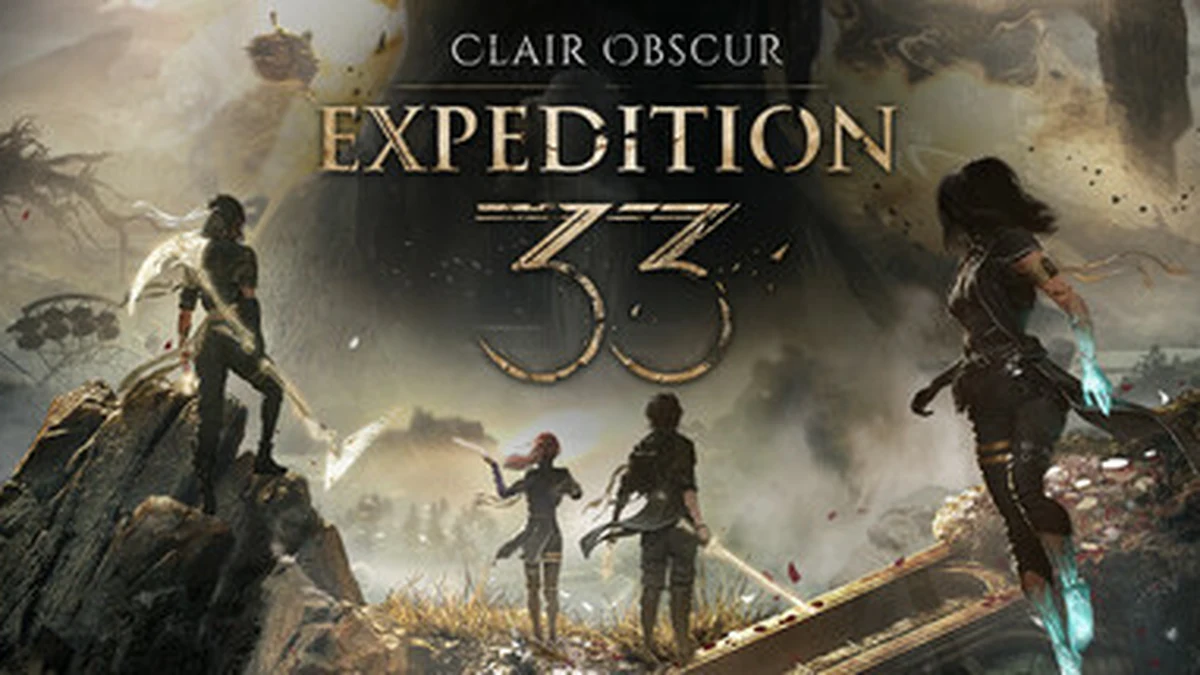
Every so often a debut studio releases something so confident it barely feels like a first attempt. Clair Obscur: Expedition 33, the maiden project from French developer Sandfall Interactive, is that kind of game — a turn-based RPG soaked in painterly grief that spent 2025 being talked about in the same breath as genre giants. It earns most of that praise. It also has real, specific problems that a wave of launch-week hype tended to gloss over, and a genuine review has to sit with both.
Story and Setting
The premise is one of the most striking hooks in recent RPG memory: on the fictional continent of Lumière, a god-like figure known as the Paintress wakes each year, paints a number on a distant monolith, and everyone whose age matches that number turns to ash and petals. The number started at 100. It is now down to 33. You lead Expedition 33, the latest in a long line of doomed volunteer parties sent to kill the Paintress before she can paint again, alongside a small cast including Gustave, Lune, Maelle, and Sciel.
What follows is a “dark fantasy Belle Époque” world — art nouveau architecture, crumbling seaside towns, and painterly monsters — married to a story about grief, mortality, and the stories people tell themselves to survive loss. The writing is genuinely mature for the genre, willing to sit in uncomfortable emotional territory rather than resolve it neatly. Where the narrative wobbles is structural: the game is built around three acts, and while the first two are tightly paced and full of momentum, the third opens with a tonal and mechanical swerve that a large portion of players found jarring, even alienating. It’s a bold swing, but not every review or player forum has landed on “worth it.”
Gameplay and Combat
The combat is the game’s headline achievement: a hybrid of classic turn-based JRPG structure and real-time reflexes. Turn order is speed-based and menu-driven like a traditional RPG, but every enemy attack can be dodged, parried, or jumped over in real time, and many of your own abilities are punctuated by quick-time inputs that boost damage if timed correctly. It’s demanding in a way turn-based combat rarely is — you can’t tab out mentally during enemy turns — and it rewards players who treat every encounter, including trash fights, with attention. Six equippable skills per character, a deep Pictos and Lumina customization layer, and genuinely inventive boss design (some of the best in any RPG this generation) keep combat fresh across a 30-hour main story or a 60-hour completionist run.
The exploration layer is weaker. Sandfall built a semi-open world connecting combat encounters and setpieces, and while it looks gorgeous, the pacing between story beats sags noticeably once the game leaves its tightly authored opening hours. Side content varies wildly in quality, and the further you get from the main critical path, the more the game’s ambitions outstrip its ability to fill space meaningfully. Character progression fares better than the map design: each party member’s kit is distinct enough that swapping your active trio changes how a fight should be approached, and the Pictos system in particular rewards experimentation by letting you mix and match passive effects gleaned from earlier encounters, essentially letting you build your own subclasses over the course of the campaign.
Visuals, Sound, and Performance
Visually, this is one of the most striking RPGs in years — the painterly art direction, character design, and environmental storytelling are consistently gorgeous, aided by a score that ranks among the best of any game released in 2025. On consoles, the game runs solidly. On PC, it’s a different story: Expedition 33 is heavily GPU-bound, and at launch only top-tier cards could sustain 60fps at 1440p on high settings. The game shipped with NVIDIA DLSS and Intel XeSS support but no AMD FSR, a notable omission that left a chunk of the PC audience with worse upscaling options, and some players reported issues with forced sharpening filters and blurriness at native resolution. Patches have chipped away at these issues since launch, but PC players with mid-range hardware should check current benchmarks before assuming a smooth ride.
Value for Money
At a standard price of $49.99, with a $59.99 Deluxe Edition adding cosmetic outfits and bonus content, Expedition 33 undercuts most full-price AAA RPG launches while delivering a campaign that comfortably runs 30 to 60 hours depending on how much side content you chase. That alone makes it a strong value proposition even before factoring in its day-one availability on Xbox Game Pass and PC Game Pass, which lets subscribers try the Standard Edition at no extra cost. For a debut studio’s first release, the amount of fully-voiced content, hand-crafted boss encounters, and original music on offer is difficult to match at this price point, even accounting for the pacing issues in the back half.
What Works
The combat system is a genuine innovation that makes turn-based RPGs feel urgent again, and the cast, particularly the central relationships, carry real emotional weight without leaning on genre clichés. Boss encounters are consistently excellent, art direction and music are best-in-class, and the first two-thirds of the game rarely lets its foot off the gas. For a debut studio, the ambition on display — mechanically and narratively — is remarkable.
What Doesn’t
The open-world connective tissue dilutes momentum, side content is inconsistent, and the divisive third act undercuts a story that had, up to that point, been building toward something cleaner. PC performance at launch left a lot to be desired for anyone without a high-end GPU, and the missing FSR support at release was a real miss for a game marketed partly through Game Pass, where hardware variety is the norm. Some encounter design in the mid-game also leans on damage-sponge difficulty spikes rather than smarter enemy behavior, which can make certain optional bosses feel like attrition tests more than skill checks.
Verdict
Clair Obscur: Expedition 33 is one of the best turn-based RPGs in years, and its combat system alone justifies picking it up if you have any affection for the genre. It’s not the flawless masterpiece some early hype cycles suggested — the back half sags, the ending divides, and PC owners without strong hardware will want to manage expectations. But for players who want a game willing to swing for genuine emotional and mechanical ambition on a debut budget, this is an easy recommendation, doubly so if you already have Xbox Game Pass or PC Game Pass, where it’s included day one. Players who prioritize tight, unbroken pacing over ambition, or who are running older PC hardware, should wait for a sale or a stronger patch cycle before diving in.