
Table of Contents
- What Is The Legend of Zelda: Tears of the Kingdom?
- Story and Setting: Hyrule Torn Apart
- Link’s New Powers: Ultrahand, Fuse, Ascend, and Recall
- Three Worlds in One: Sky, Surface, and the Depths
- Weapons, the Master Sword, and the Durability System
- Shrines, Towers, and Puzzle Design
- Side Content: Sages, Companions, and the Depths Economy
- amiibo Support
- Critical Reception and Awards
- Sales Performance
- Platforms: Nintendo Switch and Nintendo Switch 2 Compatibility
- Tips for New Players
- Who Is Tears of the Kingdom For?
- FAQ
- Conclusion
- External Authority Sources
Few sequels have had to follow an act as difficult as Breath of the Wild. Nintendo’s 2017 reinvention of Zelda redefined what an open-world game could feel like, and any follow-up risked either repeating the formula or losing what made it special. The Legend of Zelda: Tears of the Kingdom, released on May 12, 2023 exclusively for Nintendo Switch, solved that problem by keeping the same Hyrule players already knew and then rebuilding the rules underneath it. The result is not a bigger Breath of the Wild so much as a different kind of game wearing familiar scenery: a floating archipelago overhead, a poisoned underworld below, and a physics-driven building system that turns every rock, plank, and fan Link finds into potential machinery. This guide walks through the story, the new abilities, the three-layer map, the weapon system, and the practical details players actually search for — including how the game runs on Nintendo Switch 2 — so you have one complete reference whether you are deciding to buy it, just started, or are deep into your second playthrough.
What Is The Legend of Zelda: Tears of the Kingdom?
The Legend of Zelda: Tears of the Kingdom is an action-adventure open-world game developed and published by Nintendo for the Nintendo Switch, directed by Hidemaro Fujibayashi and produced by Eiji Aonuma, the longtime steward of the Zelda series. It is the direct sequel to 2017’s The Legend of Zelda: Breath of the Wild, reusing and expanding that game’s version of Hyrule rather than building a new continent from scratch. Where Breath of the Wild was defined by survival, scarcity, and open-ended exploration of a ruined kingdom, Tears of the Kingdom is defined by construction and verticality: Link can now build, fuse, and manipulate the environment in ways the original game never allowed, and the map itself has effectively tripled in usable space by adding a sky layer above Hyrule and a subterranean layer beneath it.
Mechanically, the game keeps the core Breath of the Wild loop — climb anything, glide anywhere, cook food, manage stamina and hearts, tackle shrines for permanent upgrades — but layers four new abilities on top of it that change how players approach nearly every problem. It is still an open-world game in the purest sense: there is a critical path toward defeating Ganondorf, but almost nothing stops a player from ignoring it entirely to build a raft, climb a Sky Island, or dive into a chasm and disappear into the dark for hours.
Story and Setting: Hyrule Torn Apart
Tears of the Kingdom begins with Link and Princess Zelda investigating a mysterious malady spreading beneath Hyrule Castle. In the depths below the castle, they discover a preserved, mummified corpse. That corpse belongs to Ganondorf, the Gerudo King who, according to Hyrule’s deep history, was once the vessel for the Demon King — the game’s version of the series’ recurring dark god, Demise — and who was defeated and sealed away centuries earlier by King Rauru and the ancient Zonai civilization, at the cost of Rauru’s own life. Disturbing this sealed tomb releases Ganondorf’s malice, which corrupts Link’s arm and shatters the Master Sword, while Zelda falls into the chasm that opens beneath the castle and vanishes.
From there, the story splits along two tracks that players can pursue in almost any order. In the present, Link — fitted with a new, ancient Zonai prosthetic that grants his four core abilities — sets out across Hyrule to reunite with Zelda, uncover what happened to her, and gather allies capable of standing against a resurgent Ganondorf. Scattered across the Sky Islands are geoglyphs and memories that reveal the deeper history: the ancient war between the Zonai, led by Rauru and his sister Sonia, and the newly resurrected Demon King. Piecing together this backstory is optional but central to understanding why Ganondorf returns as more powerful, and more personally vindictive, than in any previous game.
As Link travels Hyrule, he recruits the leaders of the game’s four allied races — the Gerudo, Rito, Zora, and Goron — along with a fifth companion, forming a new generation of Sages who each grant Link a usable combat ability tied to their people’s traditional powers. This structure mirrors Breath of the Wild’s four Champions but reworks it into direct, on-demand companion abilities rather than remotely-triggered Divine Beast powers.
The story eventually reveals that Zelda, in a desperate act to save Hyrule from Ganondorf’s return, traveled back in time and became intertwined with the ancient light dragon Light Dragon — a transformation that leaves her existing across the story’s timeline as a dragon Link repeatedly encounters without immediately realizing her identity. In the climax, Link unites the reformed Sages, defeats Ganondorf’s army, and duels him directly. Refusing to accept defeat, Ganondorf allows the Demon King inside him to fully take over, transforming into a colossal Demon Dragon in a last attempt to destroy Hyrule. Zelda, still in her dragon form, joins Link in the final confrontation, helping him shatter Ganondorf’s secret stone and end the threat for good.
The tone throughout is noticeably more mythic and consequential than Breath of the Wild, which largely kept its history at arm’s length through memories of a hundred years past. Tears of the Kingdom instead ties Link and Zelda directly into a founding myth of Hyrule itself, giving Ganondorf a fuller, more personal motive and giving the overall narrative a sense of closure that the previous game deliberately withheld.
Link’s New Powers: Ultrahand, Fuse, Ascend, and Recall
The four abilities Link gains from his new arm are the mechanical heart of Tears of the Kingdom, and they are what separate this game most sharply from its predecessor.
Ultrahand lets Link grab objects in the world and move, rotate, and attach them to other objects, essentially turning Hyrule into a construction set. Logs, wheels, fans, wings, carts, and hundreds of other objects can be bolted together to build rafts, cars, flying machines, bridges, and combat platforms. There is no fixed recipe system — players design their own vehicles from whatever parts they can find or fabricate — and the game’s Depths and Sky Islands are full of specialized Zonai-tech parts (fans, wheels, rockets, hydrants, flame emitters) built specifically to be combined this way. Ultrahand is also used for simpler tasks, like moving a boulder off a path or repositioning a platform to reach a ledge.
Fuse lets Link combine two items into one, most commonly attaching a material — a rock, a mushroom, a monster part, even another weapon — to the tip of a weapon, arrow, or shield to change its properties and boost its effectiveness. A stick fused with a rock becomes a crude hammer; an arrow fused with a bomb flower becomes an explosive shot; a shield fused with a spring becomes a launch platform. Fuse is also the game’s primary answer to Breath of the Wild’s much-criticized weapon fragility, since fused materials add extra durability on top of a weapon’s base value.
Ascend allows Link to swim upward through solid ceilings and platforms above him, emerging on the surface directly overhead as long as there is a valid space to appear in. It solves vertical traversal problems that previously required careful climbing or a glide, letting players shortcut through cave ceilings, overhangs, and multi-level structures instantly.
Recall reverses the recent motion of an object, effectively rewinding it along the path it just traveled. It is most famously used to ride falling rocks back up to the Sky Islands they fell from, but it also works on moving platforms, thrown objects, and enemy projectiles, giving it uses in both traversal and combat.
Together these four abilities, plus the returning Magnesis-style and bomb-like tools reworked into Ultrahand and Fuse, form a toolkit that rewards experimentation far more than Breath of the Wild’s rune set did. Nintendo also added an Autobuild feature later accessible in the story that lets players instantly reconstruct previously built vehicles from a menu, which softens the time cost of Ultrahand’s more elaborate builds.
Three Worlds in One: Sky, Surface, and the Depths
Tears of the Kingdom’s Hyrule is built as three distinct, vertically stacked layers, each with its own rules, hazards, and rewards.
The Sky layer consists of floating islands scattered above Hyrule, ranging from small platforming challenges to substantial landmasses with their own puzzles, enemies, and shrines. Many Sky Islands hold Zonai survey devices and ancient geoglyphs that reveal chapters of the game’s backstory. Getting to and around the Sky Islands typically depends on updrafts, Ultrahand-built gliders and flying machines, and the game’s network of Skyview Towers.
The Surface is the familiar Hyrule from Breath of the Wild, altered by new chasms, updated terrain, and the addition of Great Sky Islands and Skyview Towers punching up out of it. Fifteen Skyview Towers are scattered across Hyrule’s surface regions; activating one launches Link skyward for a bird’s-eye view that unfogs the surrounding portion of the surface map, functioning as this game’s equivalent of Breath of the Wild’s Sheikah Towers.
The Depths is the game’s most significant new addition: a vast, near-lightless underground layer that mirrors the surface map in scale. The Depths is reached by falling through chasms that pockmark the surface, and it is shrouded in darkness that only lifts around Lightroots — glowing beacons that, once activated, illuminate the surrounding area and reveal that portion of the Depths map. There are 120 Lightroots scattered through the Depths, each one positioned directly beneath one of the game’s shrines on the surface. The Depths is also home to Bargainer Statues, poes, valuable ore deposits including Zonaite, and Gloom — a corrupting hazard that damages Link’s hearts in a way regular healing cannot immediately restore. It is a meaningfully more dangerous, resource-rich space than the surface, designed for players willing to explore with fewer landmarks and a real risk of getting lost.
Weapons, the Master Sword, and the Durability System
Tears of the Kingdom keeps Breath of the Wild’s core weapon durability system — nearly every weapon, bow, and shield Link picks up will eventually break with use — but changes how players interact with it through Fuse. Rather than simply cycling through a growing inventory of disposable weapons, players can attach materials to extend durability and add elemental or utility effects, turning a mundane weapon into something purpose-built for a specific fight. Fusing tougher materials, like certain monster parts or ore, generally grants more bonus durability and higher damage than fusing common items like sticks or mushrooms.
The Master Sword returns as the series’ iconic blade, and it behaves differently from every other weapon in the game. When its durability is depleted through use, it does not break permanently the way ordinary weapons do; instead, it enters a cooldown state and becomes unusable for a set period of real time before recharging on its own. This makes it a reliably durable centerpiece weapon rather than a strict best-in-slot option, since players cannot indefinitely repair it through fusing the way they can other weapons. The Master Sword can also be fused with materials and Zonai devices, including cannons, which produces distinct visual effects — glowing Zonai script appears along the blade when fused, visible when the weapon is swung.
Zonai devices deserve their own mention here, since they are as central to combat as traditional weapons. Bomb flowers return in a directly-throwable form, while Zonai capsules found and purchased throughout the game — springs, wheels, fans, flame emitters, and more — provide the building blocks for both weapons and vehicles, blurring the line between combat prep and construction.
Shrines, Towers, and Puzzle Design
Shrines remain the primary unit of puzzle content and progression, just as in Breath of the Wild. There are 152 shrines scattered across Hyrule’s surface and Sky Islands, each a self-contained puzzle or combat challenge that rewards a Light of Blessing on completion. Collecting four Lights of Blessing lets players choose to upgrade either Link’s maximum hearts or his stamina wheel at a Goddess Statue, the same trade-off system from the previous game.
Because Ultrahand, Fuse, Ascend, and Recall are so central to traversal and problem-solving, many shrines are built specifically to test one of these abilities in isolation — an Ascend-only vertical shaft, a Recall puzzle involving a falling platform, an Ultrahand construction challenge to cross a gap. This design choice makes shrines feel more tightly tied to the game’s unique mechanics than Breath of the Wild’s, which mostly tested the four Sheikah Slate runes and general combat or stealth skills.
Skyview Towers function as the game’s map-revealing structures, similar in purpose to Breath of the Wild’s Sheikah Towers but reworked to launch Link into the sky rather than simply granting a high vantage point, tying tower activation directly into the new vertical structure of the world. Activating all 15 towers is generally the fastest way to unfog the surface and sky maps and identify shrine locations from a distance.
Side Content: Sages, Companions, and the Depths Economy
Beyond the main story, Tears of the Kingdom is dense with side quests, shrine quests, and Korok-hunting content carried over conceptually from Breath of the Wild, alongside new systems introduced specifically for this game. Recruiting each regional Sage — representing the Gerudo, Rito, Zora, Goron, and a fifth ally — typically involves a substantial regional questline that resolves a local conflict tied to Ganondorf’s influence, and completing it grants Link a permanent companion ability usable in combat, such as elemental attacks or defensive support.
The Depths introduces its own economy built around Bargainer Statues, shrines to a mysterious figure named Bargainer, where players spend Poes — a currency found only in the Depths — to purchase armor pieces, including full sets tied to previous Zelda games as a nod to the series’ history. Zonaite, an ore unique to the Depths, is a key crafting resource for battery capacity upgrades, which govern how long Zonai devices can be powered during Ultrahand builds. This creates a loop where surface exploration, Sky Island discovery, and Depths mining all feed back into strengthening Link’s building and combat capabilities, tying the three layers of the map together mechanically rather than leaving them as separate, disconnected spaces.
amiibo Support
Tears of the Kingdom supports amiibo figures in the same spirit as previous mainline Zelda titles. Every amiibo figure works with the game, including ones from outside the Zelda series, though non-Zelda amiibo generally only produce cooking and crafting materials. Zelda-specific amiibo, including the Tears of the Kingdom Link figure and figures from earlier games, produce more valuable and thematically relevant rewards, such as fabric that changes the visual pattern of Link’s paraglider — cosmetic rewards that cannot be obtained any other way in the game.
The Wolf Link amiibo behaves differently than it did in Breath of the Wild: rather than summoning a Wolf Link companion to fight alongside Link, it instead yields large amounts of meat for cooking and fusing, along with a chance at unlocking Twilight Princess-themed armor pieces, including an exclusive Mirror of Twilight paraglider fabric. amiibo rewards are generally randomized and limited to one scan per figure per day, encouraging players to return regularly rather than farm a single figure repeatedly in one sitting.
Critical Reception and Awards
Tears of the Kingdom was met with near-universal critical acclaim on release. It holds a score of 96 on Metacritic based on critic reviews, placing it among the highest-rated games ever released on Nintendo Switch, alongside Breath of the Wild and Super Mario Odyssey. Reviewers consistently praised the freedom and creativity enabled by Ultrahand and Fuse, the scale of the three-layer map, and the way the game builds meaningfully on its predecessor rather than simply repeating it. The most common criticism raised by reviewers centered on the complexity of the game’s controls, particularly around managing the building and fusing systems, which some found to have a steeper learning curve than Breath of the Wild’s simpler rune-based tools.
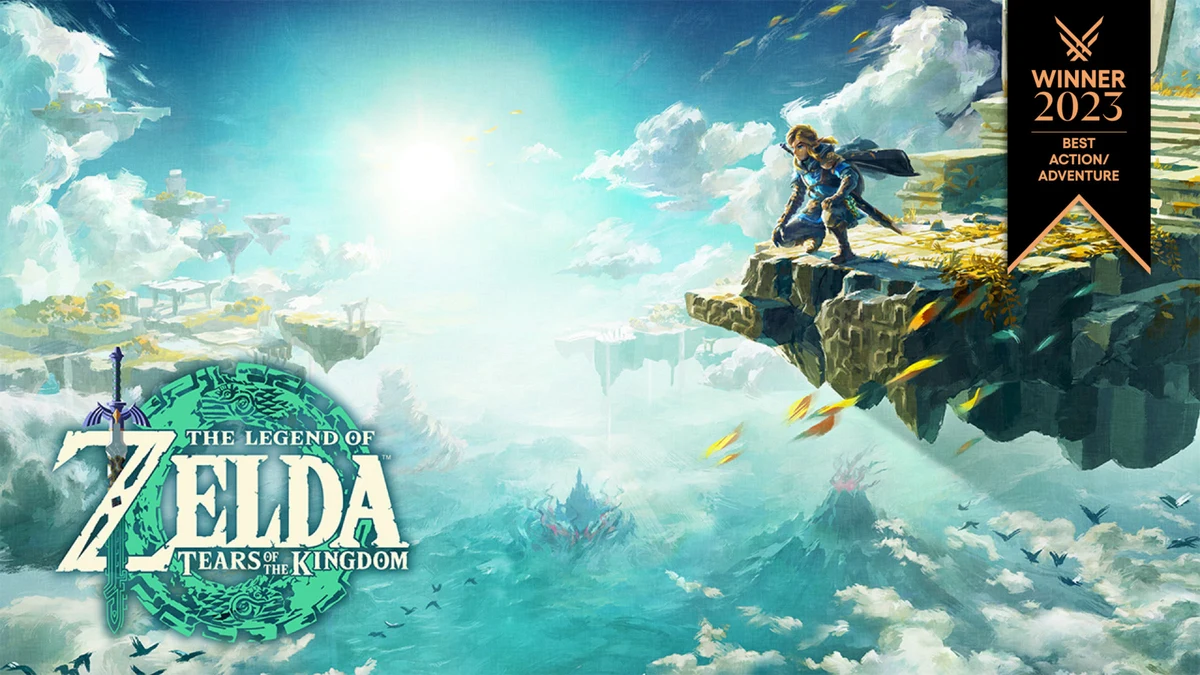
At The Game Awards 2023, Tears of the Kingdom was nominated across six categories and won Best Action/Adventure Game, though it lost the night’s overall Game of the Year award to Baldur’s Gate 3. It also won Best Game at Gamescom 2023, taking more awards at that show than any other title that year, and it received recognition from numerous other outlets and award bodies through the rest of 2023 as one of the year’s standout releases.
Sales Performance
Tears of the Kingdom was also a commercial success on a scale matching its critical reception. The game sold roughly 10 million copies worldwide in its first three days on sale, making it the fastest-selling entry in the history of the Zelda franchise. By the end of June 2023 — roughly seven weeks after launch — sales had reached 18.51 million units, and by the end of calendar year 2023 that figure had grown to over 20 million units sold. As of mid-2025, lifetime sales stood at approximately 21.93 million units, placing Tears of the Kingdom among the best-selling games ever released on Nintendo Switch and helping drive a record-breaking quarter for Nintendo in the months following launch.
Platforms: Nintendo Switch and Nintendo Switch 2 Compatibility
Tears of the Kingdom launched exclusively on the original Nintendo Switch on May 12, 2023, and the base game continues to run on that hardware. Owners of the original Switch cartridge or digital copy can play it as-is on Nintendo Switch 2 through backward compatibility, and Nintendo Switch Online + Expansion Pack members gain access to a Nintendo Switch 2 upgrade pack for the game, which enables improvements such as better framerates, faster load times, and enhanced resolution and textures when playing on the newer hardware. Ownership of the original Nintendo Switch version is required to use the upgrade pack.
Nintendo also released a standalone Legend of Zelda: Tears of the Kingdom – Nintendo Switch 2 Edition, priced around 80 dollars, which bundles the base game together with its Switch 2 upgrade content. This edition adds Zelda Notes, a game-specific companion service built into the Nintendo Switch app that offers voice-assisted navigation support and additional voice-recorded material from Zelda and other characters not present in the original release, as well as GameChat support for talking with friends while playing on Nintendo Switch 2. One important caveat worth noting for players relying on cloud backups: Nintendo’s own product pages for the Switch 2 Edition state that this version does not support the Nintendo Switch Online paid membership’s Save Data Cloud backup feature, so players should keep that limitation in mind when managing save files across systems.
Tips for New Players
Getting comfortable with Tears of the Kingdom’s systems takes a bit longer than most open-world games, mainly because Ultrahand and Fuse have almost no ceiling on complexity. A few practical starting points make the early hours smoother.
Spend real time experimenting with Fuse before worrying about optimal combinations. Attaching almost any material to a weak weapon meaningfully improves it, and there is no penalty for trying combinations that turn out to be mediocre — the fused material can simply be swapped out later. Keep an eye out for materials with elemental properties, since fusing them to arrows is often more efficient than fusing them to melee weapons, letting a single material go further across multiple encounters.
Do not rush into the Depths without preparing first. The darkness and Gloom hazard make it a genuinely dangerous early-game space, and it rewards players who have already picked up some brightbloom seeds — which illuminate the area when thrown — and built up a cushion of hearts. Activating Lightroots as they are found gradually turns the Depths from disorienting to navigable.
Treat the Master Sword as a reliable fallback rather than a weapon to hoard. Because it enters a cooldown instead of breaking outright, it is more forgiving to use regularly than trying to preserve rare weapons for emergencies that may never come.
Finally, prioritize the four Skyview Towers nearest the starting areas early on, since unfogging the map dramatically speeds up shrine-hunting and general orientation, and consider tackling regional Sage questlines roughly in the order they are introduced rather than saving them all for the end, since each Sage ability meaningfully changes how combat feels for the rest of the playthrough.
Who Is Tears of the Kingdom For?
Tears of the Kingdom is built for players who enjoy open-ended systems more than tightly scripted challenge. Anyone who found Breath of the Wild’s structure appealing — minimal hand-holding, a huge map that rewards curiosity, combat and traversal problems with multiple valid solutions — will find that Tears of the Kingdom takes those same values further, with Ultrahand in particular appealing to players who enjoy sandbox-style creativity, engineering puzzles, and emergent problem-solving rather than a fixed toolkit.
It is a less natural fit for players who prefer a more directed, linear adventure with a tightly paced story, since the game deliberately puts enormous amounts of content — including major story beats — behind player initiative rather than a forced critical path. The learning curve around building and fusing can also be a genuine barrier for players who are not interested in engaging with menus and construction mechanics, even though the game does not strictly require elaborate Ultrahand creations to reach the credits. For anyone weighing whether to start with Breath of the Wild first, doing so is not mandatory to understand or enjoy Tears of the Kingdom’s story, though playing the original does add context to the returning cast, setting, and the weight of the corrupted Hyrule Castle at the game’s opening.
FAQ
Do I need to play Breath of the Wild before Tears of the Kingdom? No. Tears of the Kingdom is designed to stand on its own, and its story is self-contained enough for new players to follow without prior knowledge of Breath of the Wild. Playing the earlier game does add context to returning characters, locations, and the state of Hyrule at the start of the sequel, but it is not a requirement.
What are the four new abilities Link gets in Tears of the Kingdom? Link’s new abilities are Ultrahand, which lets him grab, move, and attach objects to build vehicles and structures; Fuse, which lets him combine materials with weapons, arrows, and shields to boost their power and durability; Ascend, which lets him rise through solid ceilings to the surface directly above him; and Recall, which reverses an object’s recent movement, most commonly used to ride falling debris back up to where it came from.
Does the Master Sword still break in Tears of the Kingdom? The Master Sword’s durability can still run out from use, but unlike every other weapon in the game, it does not break permanently. Instead, it enters a cooldown period, becoming unusable for roughly ten real-world minutes before it recharges and can be wielded again.
How big is the Depths compared to the surface map? The Depths is roughly the same size and shape as Hyrule’s surface map, effectively doubling the game’s explorable terrain on top of the added Sky Islands. It is mostly shrouded in darkness, revealed gradually by activating 120 Lightroots scattered throughout the underground layer.
Can I play Tears of the Kingdom on Nintendo Switch 2? Yes. The original Nintendo Switch version is backward compatible with Nintendo Switch 2, and Nintendo Switch Online + Expansion Pack members who own the original game can access a free upgrade pack for improved performance and visuals. Nintendo also sells a standalone Nintendo Switch 2 Edition bundling the base game with its upgrade content and the Zelda Notes companion feature, though this edition does not support Nintendo Switch Online’s Save Data Cloud backup.
How does amiibo support work in Tears of the Kingdom? Every amiibo figure is compatible with the game. Zelda-series amiibo generally unlock more meaningful rewards, including paraglider fabric patterns and, in the case of the Wolf Link amiibo, Twilight Princess-themed armor pieces and cooking materials. Non-Zelda amiibo mostly yield general crafting and cooking ingredients. Rewards are randomized and limited to one scan per figure per day.
Conclusion
The Legend of Zelda: Tears of the Kingdom succeeds by treating its predecessor as a foundation rather than a finished formula. Keeping Hyrule’s surface largely intact while adding a fully realized sky layer and an equally vast underground counterpart gives the game scale without demanding players relearn the map from scratch, and the four new abilities — Ultrahand, Fuse, Ascend, and Recall — genuinely change how problems get solved rather than simply adding cosmetic new tools. That combination of familiarity and reinvention is a large part of why the game earned a 96 on Metacritic, sold roughly 22 million copies within two years, and continues to be played on both the original Nintendo Switch and, with an upgrade pack or dedicated edition, on Nintendo Switch 2. Whether you are drawn in by the story of Ganondorf’s return, the promise of building your own flying machine out of scrap Zonai parts, or simply the chance to explore a Hyrule three layers deep, Tears of the Kingdom rewards the same kind of curiosity that made Breath of the Wild a landmark game in the first place — and it does so with enough new mechanical depth to stand as a distinct achievement in its own right.