
Table of Contents
- What Is Halo Infinite?
- Story and Setting: Zeta Halo, the Banished, and Cortana
- The Campaign: A Semi-Open World Halo
- Multiplayer: Free-to-Play Arena, Big Team Battle, and Ranked
- The Battle Pass and Season Model
- Forge Mode: Halo Infinite’s Creation Suite
- Weapons, Equipment, and Spartan Abilities
- Platforms, Game Pass, and Cross-Play
- The Current State of Halo Infinite in 2026
- Critical Reception
- Tips for New and Returning Players
- Who Is Halo Infinite For?
- FAQ
- Conclusion
- External Authority Sources
Master Chief’s return in 2021 carried more weight than any Halo launch since the original trilogy closed out. After the divisive detour of Halo 5: Guardians and a development cycle marked by a delayed reveal, an engine rebuild, and a widely mocked first gameplay trailer, 343 Industries needed Halo Infinite to do two things at once: tell a story that felt like Halo again, and reinvent the multiplayer formula for a free-to-play era dominated by Fortnite, Apex Legends, and Warzone. Remarkably, it mostly succeeded on both fronts. The campaign traded the linear corridors of past entries for a semi-open ring world, giving players a grappling hook and a Warthog and letting them decide how to dismantle the Banished occupation of Zeta Halo. The multiplayer, released free on every platform a full three weeks before the campaign, became the most-played Halo launch in Xbox history.
Halo Infinite has had a strange life since then — a rocky launch year overshadowed by thin content and aggressive monetization, a genuine turnaround through 2022 and 2023 as co-op and Forge arrived, and a quieter final stretch as its developer (rebranded Halo Studios) shifted attention to new projects. This guide covers everything a player needs to know in 2026: the story, the systems, the current live-service status, and whether it is still worth installing today.
What Is Halo Infinite?
Halo Infinite is a first-person shooter developed by 343 Industries (now operating under the studio name Halo Studios) and published by Xbox Game Studios. It released on November 15, 2021 for multiplayer and December 8, 2021 for the campaign, launching simultaneously on Xbox One, Xbox Series X|S, and Windows PC, with day-one availability on Xbox Game Pass. It serves as the sixth mainline entry in the Halo franchise and a direct narrative sequel to Halo 5: Guardians, following the events of the Reclaimer Saga that began with Halo 4.
The game is split into two components that are often discussed separately because they operate under different business models. The campaign is a single-player (and later co-operative) story-driven shooter sold as a standalone product or included with Xbox Game Pass. The multiplayer is entirely free-to-play, available to anyone regardless of whether they own the campaign, and monetized through cosmetic purchases and a Battle Pass rather than pay-to-win mechanics. This split was a deliberate strategy: it let 343 Industries maximize the multiplayer’s audience while still selling a premium campaign experience to players who wanted the story.
Under the hood, Halo Infinite runs on a heavily reworked version of the Slipspace Engine, the same core technology used in Halo 5. The engine overhaul enabled dynamic time-of-day lighting, a much larger draw distance, and the open-world traversal systems that define the campaign’s back half. On Xbox Series X|S, the game targets 60 frames per second (with higher frame rate options in multiplayer), and it was one of the more visible showcases of what the Series X|S generation could do at launch, alongside supporting cross-generation play with Xbox One.
Story and Setting: Zeta Halo, the Banished, and Cortana
Halo Infinite is set in the year 2560, roughly six months after the events of Halo 5: Guardians. During that game’s climax, the AI Cortana — Master Chief’s longtime companion, who had been diagnosed with the AI degradation condition known as rampancy — seized control of ancient Forerunner war machines called Guardians and declared herself the galaxy’s new ruler under the doctrine of “the Mantle of Responsibility.” Her rebellion, and the UNSC’s failure to stop her, form the backdrop against which Halo Infinite opens.
The story begins with Master Chief adrift in space, severely damaged and without an AI companion, having apparently lost a confrontation with the Banished warlord Atriox. He is rescued by a UNSC pilot, Fernando Esparza, who becomes his reluctant ally and one of the game’s more grounded, human supporting characters. The two make their way to Installation 07, a Forerunner ringworld better known by its nickname, Zeta Halo. The ring has been damaged and partially “unraveled,” and it is now occupied by the Banished, a mercenary army of Brutes, Jiralhanae, and other alien factions that splintered from the Covenant years earlier.
The Banished are led in Master Chief’s absence by Escharum, a battle-scarred Jiralhanae war chief serving under Atriox, who commands the occupying forces on Zeta Halo while searching for the source of the ring’s power. Unlike the Covenant’s religious zealotry, the Banished are defined by raw martial pragmatism and a code of strength-based respect, which makes Escharum a more personal, almost mentor-like antagonist to Chief across the campaign — the two develop a grudging mutual respect even as they try to kill each other.
Central to the plot is Master Chief’s search for Cortana and his discovery of “the Weapon,” a new AI constructed using Cortana’s original neural pattern and physical likeness. The Weapon was built specifically to infiltrate and disable Cortana, but she reveals that she never completed her final directive to self-destruct after the mission, leaving her stranded and uncertain of her own purpose. Her presence throughout the campaign echoes the original Master Chief-Cortana dynamic from the early 2000s trilogy while raising new questions about identity, autonomy, and what it means to be a copy of someone else’s mind. As the campaign progresses, players uncover the fate of the UNSC Infinity’s crew, the truth behind Zeta Halo’s damage, and Cortana’s ultimate reckoning with the consequences of her rebellion — a resolution that closes the loop on one of the franchise’s longest-running character arcs while opening the door to new story threads for whatever comes next in the saga.
The Campaign: A Semi-Open World Halo
The single biggest structural change in Halo Infinite is its campaign design. Rather than stringing together a series of self-contained linear levels the way every previous mainline Halo did, Infinite uses Zeta Halo itself as a semi-open hub world. Players can freely traverse a large section of the ring in a Warthog, Mongoose, Banshee, or on foot, tackling story missions in a rough recommended order while also pursuing an extensive layer of side content whenever they choose.
That side content includes liberating Forward Operating Bases (FOBs), which act as fast-travel points, vehicle and weapon spawn stations, and unlock hubs; assaulting High-Value Targets, mini-boss-style Banished commanders who drop unique weapon variants when defeated; destroying Banished propaganda towers; rescuing marines held in outposts, who then join Chief’s growing squad of AI-controlled allies; and collecting Spartan Cores, a currency used to permanently upgrade Chief’s equipment, such as increasing Grappleshot range or reducing cooldowns on other tools. The open sections are bookended by more traditional, tightly scripted linear missions inside Forerunner and Banished interior facilities, which is where the game leans hardest into classic Halo level design, large combat arenas, and set-piece moments.
This hybrid approach was a deliberate answer to criticism of Halo 4 and Halo 5, which many longtime fans felt strayed too far from the sandbox-driven, systemic combat that defined Halo: Combat Evolved and Halo 3. By giving players a mobility tool (the Grappleshot) and an open battlespace to use it in, 343 Industries built encounters that reward creative problem-solving — grappling onto a Banshee mid-flight to hijack it, using the terrain to flank a Banished stronghold, or calling in a vehicle from a captured FOB before an assault — rather than following a fixed critical path.
Campaign co-op, a feature present in every mainline Halo since Halo 2, was notably absent at launch, a decision that frustrated a significant part of the community. 343 Industries added two-to-four-player online co-op in Season 2 (mid-2022), along with a mission replay feature that let players revisit specific story missions and side activities without restarting the entire campaign. Split-screen co-op, a Halo tradition going back to the original Xbox, was ultimately never implemented for the campaign, which remains one of the more persistent criticisms from long-time fans of the series.
Multiplayer: Free-to-Play Arena, Big Team Battle, and Ranked
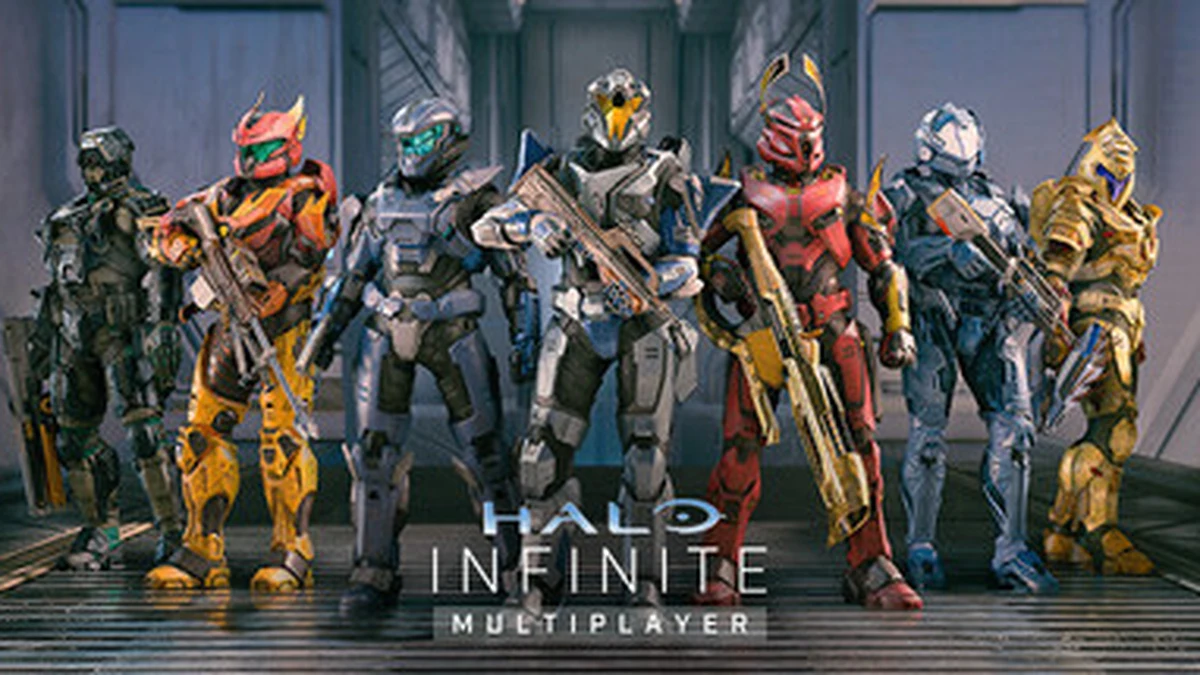
Halo Infinite’s multiplayer is built around the series’ traditional Arena combat: symmetric, skill-based encounters emphasizing weapon pickups, map control, and precise gunplay over the class-based loadout systems common in many modern shooters. Every player starts a match with the same base loadout and picks up power weapons and equipment placed around the map, preserving the sandbox-driven balance the franchise is known for.
The core social and ranked playlists run on smaller, competitively focused maps supporting up to 8 players (4v4), covering classic modes including Slayer, Capture the Flag, Oddball, King of the Hill, and Strongholds. Alongside these sits Big Team Battle (BTB), Halo’s large-scale vehicular warfare mode, which Infinite expanded to 24 players — two teams of twelve — on sprawling maps built around Warthogs, Scorpions, Banshees, and Wasps. BTB has consistently been one of the most popular playlists in the game, giving casual and hardcore players alike a sandbox for full-scale vehicle combat that the smaller Arena maps can’t accommodate.
Ranked play centers on a per-playlist Competitive Skill Rank (CSR) system, tiered from Bronze through Silver, Gold, Platinum, Diamond, and Onyx, with players climbing or falling based on match performance and wins relative to opposing skill level. Ranked Arena covers the standard competitive game types (Slayer, CTF, Oddball, King of the Hill, and Strongholds), and Halo Infinite has maintained an active Halo Championship Series esports scene built on top of this ranked framework, with 343 Industries and later Halo Studios continuing to run seasonal competitive updates and rank resets. A dedicated Ranked Doubles and Ranked Team Slayer rotation has also been offered at various points, giving competitive players more granular playlists beyond the core Arena rotation.
Beyond BTB and ranked Arena, the game has periodically featured limited-time and rotating modes such as Fiesta (randomized weapon drops), Infection (a fan-favorite mode returning from earlier Halo titles, formalized as a permanent mode in Season 4), Land Grab, and various community-voted playlists, giving the live-service calendar variety between major content seasons.
The Battle Pass and Season Model
Halo Infinite’s multiplayer is entirely free-to-play — there is no cost to download it or to access any competitive mode, map, or weapon. Monetization runs entirely through cosmetics: armor coatings, weapon skins, emblems, armor kits, and other visual customization, none of which affect gameplay balance. This was a deliberate departure from Halo 5’s controversial “microtransaction card pack” system and was pitched by 343 Industries as a more player-respectful model.
The primary vehicle for this cosmetic economy is the Battle Pass, tied to seasonal content drops the game calls “Operations.” Unlike many live-service Battle Passes that expire and become unpurchasable once a season ends, Halo Infinite’s passes do not expire — a player who buys a pass can keep progressing through its reward tiers indefinitely, even years later, alongside whatever the current season’s pass is. Progression is driven by challenges (daily and weekly objectives that grant XP) rather than pure match-count grinding, a system 343 Industries adjusted more than once after community pushback about challenges being too restrictive or requiring specific, unfun playstyles to complete efficiently.
Seasons have introduced new maps, modes, weapons, and story-adjacent content through in-universe “Operations” briefings, alongside limited-time Events that offer their own smaller free and premium reward tracks tied to specific weekends or short campaigns. Over the game’s lifespan, this model evolved substantially: early seasons were criticized for slow content cadence and a bare-bones customization system that locked armor pieces to specific cores (preventing full mix-and-matching), while later seasons loosened those restrictions, added more generous free-tier rewards, and sped up the pace of new content, which helped repair the game’s reputation through 2022 and 2023.
Forge Mode: Halo Infinite’s Creation Suite
Forge, the franchise’s map and mode creation toolset, has been part of Halo’s identity since Halo 3, and Halo Infinite’s version is by a wide margin the most powerful iteration built to date. It did not launch with the game; 343 Industries released Forge in a public beta state in November 2022, refining it over the following months before treating it as a fully supported, ongoing feature of the game’s live-service roadmap.
Halo Infinite’s Forge gives players object-level scripting tools, custom lighting and weather, terrain sculpting, and full mode-logic scripting comparable to a simplified game engine, letting the community build everything from faithful remakes of classic Halo maps to entirely original game modes that have nothing to do with traditional Halo combat. Up to eight players can collaborate in a shared co-Forging session in real time, and later updates added a Forge AI Toolkit, introduced around Season 5, which lets creators place and script AI-controlled combatants directly into custom maps — enabling player-built PvE content, horde modes, and scripted campaign-style encounters that didn’t previously exist in the game.
To surface this flood of community content, 343 Industries added a Custom Games Browser (CGB) in December 2022, letting players browse and instantly join active custom lobbies running community-made maps and modes, rather than needing to manually invite friends or search external community sites. Popular Forge creations have periodically been promoted into official matchmaking rotations, effectively letting community-built maps sit alongside developer-made ones in real playlists — something the franchise has done in earlier games but rarely at this scale. Within its first several months of general availability, the Forge beta reportedly crossed one million total player-made creations, underscoring how much of the game’s ongoing content variety now comes directly from its community rather than from the studio alone.
Weapons, Equipment, and Spartan Abilities
Halo has always distinguished itself through its sandbox — a relatively small, carefully tuned roster of weapons where every gun has a clear identity and a clear counter, rather than dozens of interchangeable options. Halo Infinite continues that philosophy while introducing several new weapons alongside returning series staples.
On the UNSC side, players will find the MA40 Assault Rifle and BR75 Battle Rifle as core starting weapons, the Sidekick pistol, the VK78 Commando, the Bulldog shotgun, and the S7 Sniper. The Banished sandbox includes the Mangler (a hard-hitting sidearm), the Ravager, the Shock Rifle, the Skewer (a devastating one-hit anti-vehicle spike launcher), the Disruptor, the Cindershot, and the Heatwave. Covenant-derived weapons return as well, including the Needler, the Plasma Pistol-successor Pulse Carbine, the Sentinel Beam, and iconic power weapons like the Energy Sword and Gravity Hammer, both prized for their instant-kill melee potential and highly contested spawn locations on maps.
Equipment items are a signature new layer added in Infinite, functioning as reusable tactical tools on cooldown rather than one-time pickups. The Grappleshot is the headline addition and arguably the single most transformative tool in franchise history — usable in both campaign and multiplayer, it lets players yank themselves toward terrain or enemies, snag weapons and objects from a distance, and rapidly reposition in combat, fundamentally changing how both traversal and firefights play out compared to previous Halo games. Other equipment includes the Repulsor (a directional energy blast that knocks back enemies, objects, and even grenades), the Threat Sensor (a proximity-based enemy-detection pulse), the Drop Wall (a deployable energy shield), the Active Camouflage returning from earlier games, and the Shroud Screen, which creates a vision-blocking smoke field.
Core Spartan movement abilities — Sprint, Slide, Clamber, and Smart-Scope aiming (which lets any weapon be aimed down sights without a dedicated scope) — are all built into the base Spartan kit rather than being unlockable equipment, a change from earlier games like Halo: Reach and Halo 5, which tied more advanced mobility to specific loadouts. This baseline movement kit, combined with the Grappleshot, gives Halo Infinite noticeably faster, more vertical combat encounters than most of the franchise’s history.
Platforms, Game Pass, and Cross-Play
Halo Infinite launched day-one across Xbox One, Xbox Series X|S, and PC, and it has remained available on all three platforms continuously since 2021. On PC, the game is available through both Steam and the Microsoft Store/Xbox app, giving players a choice of storefront without splitting the community, since both versions share the same multiplayer population.
The campaign is included at no extra cost with an active Xbox Game Pass or PC Game Pass subscription, and it also supports Xbox Cloud Gaming for members who want to stream the game to unsupported devices. The multiplayer, being entirely free-to-play, requires no purchase or subscription at all to play core modes — though an Xbox Game Pass Ultimate or Xbox Live Gold-equivalent subscription (folded into modern Xbox Game Pass tiers) is generally required for online multiplayer on console, consistent with Xbox’s standard online play requirements; PC players face no such subscription requirement to play online.
Full cross-play is supported across Xbox One, Xbox Series X|S, and PC, meaning friends can party up and matchmake together regardless of which platform they’re on. Full cross-progression is also supported, so armor customization, Battle Pass progress, challenge completion, and campaign save data all carry over seamlessly if a player moves between, say, an Xbox Series X at home and a Windows PC laptop. Halo Infinite has not released on PlayStation or Nintendo platforms, remaining an Xbox-ecosystem-exclusive title (Xbox consoles, Windows PC, and cloud streaming), unlike some more recent Xbox first-party releases that have expanded to PlayStation.
The Current State of Halo Infinite in 2026
Halo Infinite’s live-service story has gone through three distinct phases. The launch period (late 2021 through 2022) was defined by strong critical reception for the campaign and multiplayer core loop, undercut by real frustration over missing features (no campaign co-op, no Forge, no theater mode at launch), a restrictive armor customization system, and a slow post-launch content cadence that left the game feeling thin during its first several months. The recovery period (roughly 2022 through 2024) saw 343 Industries systematically address that criticism: campaign co-op and mission replay arrived in Season 2, Forge exited beta and became a fully supported creative platform, the Custom Games Browser gave community content a real home, matchmaking and progression systems were reworked multiple times based on player feedback, and new modes like a formalized Infection playlist broadened the game’s appeal. This stretch is widely regarded as Halo Infinite’s best period, with community sentiment and user review scores recovering substantially from the rocky launch.
The final phase began taking shape through 2024 and 2025 as 343 Industries rebranded itself as Halo Studios and confirmed it was working on multiple new Halo projects simultaneously, including Halo: Campaign Evolved, a remake of the original 2001 Halo: Combat Evolved campaign announced for release on Xbox Series X|S, PC, and — notably, breaking Xbox’s console-exclusivity pattern for the franchise — PlayStation 5. In late 2025, Halo Studios announced that Halo Infinite would receive its final major content update, called Operation: Infinite, which launched on November 18, 2025, bringing new armor, maps, challenges, and a 2x XP period. The studio was explicit that this update was the last major content drop currently planned for the game, citing the need to focus its combined development resources on new titles in the pipeline.
Importantly, “final major content update” does not mean the game is being shut down. Halo Studios has stated it will continue supporting Halo Infinite’s live multiplayer with ongoing ranked seasons and rank resets, ongoing challenges, community events, and matchmaking support, meaning the population-facing infrastructure of the game remains active even without new maps or Operations arriving on a regular cadence. For players in 2026, this means Halo Infinite functions similarly to a “finished,” content-complete live-service game: the full existing library of maps, modes, Forge tools, and multiple years of accumulated (non-expiring) Battle Passes remain playable and purchasable, but the era of regular new-content seasons has effectively concluded. Anyone picking up the game today is getting the complete, mature version of Halo Infinite rather than an early-access-feeling live service still finding its footing — arguably the best time to jump in from a pure content-volume standpoint, even if the promise of new seasonal content going forward is off the table.
Critical Reception
Halo Infinite launched to strong critical reviews. On Metacritic, the Xbox Series X version holds a score in the high 80s based on dozens of critic reviews, while the PC version scored somewhat lower, in the low-to-mid 80s. OpenCritic aggregated a similarly strong critical consensus, with the large majority of critics recommending the game. Several major outlets, including Windows Central, VG247, GamesBeat, and Inverse, awarded the Xbox Series X version a perfect or near-perfect score, praising the campaign’s open structure, the Grappleshot’s impact on both traversal and combat, the strength of the returning Master Chief-Cortana-adjacent narrative through the Weapon, and the tightness and accessibility of the multiplayer’s core gunplay.
Critical praise consistently centered on a few pillars: the multiplayer’s return to classic, sandbox-driven Arena combat after the more loadout-heavy design of Halo 5; the campaign’s semi-open world giving players real agency in how they approached Zeta Halo; and the game’s technical presentation on Xbox Series X|S, which many reviewers cited as a genuine showcase for the new console generation.
User reception told a more complicated story, at least initially. While many players agreed the multiplayer’s core gameplay and the free-to-play accessibility were high points, a vocal segment of the community pushed back hard against the game’s monetization — full armor sets locked behind expensive Battle Pass tiers or store bundles, restrictive customization that prevented mixing pieces across different “armor cores,” and a slow post-launch content cadence relative to competing live-service shooters. This backlash was visible in review-bombing on user review aggregators shortly after launch. However, as 343 Industries shipped the fixes described in the previous section — co-op, Forge, looser customization rules, a friendlier progression system, and a steadier stream of new content through 2022 and 2023 — user sentiment recovered considerably, and Halo Infinite is generally regarded today as having stuck the landing on its long-term redemption arc, even if the initial launch stumbled in ways that damaged some of its early momentum and long-term active player counts.
Tips for New and Returning Players
Players jumping into Halo Infinite for the first time, or returning after time away, should know a few practical things to get oriented quickly.
Start with the campaign if story matters to you, and consider playing it in co-op if you have friends also picking up the game — the addition of online co-op significantly changes the pacing and feel of the open-world sections, since squad-based tactics against Banished strongholds play very differently with a human team versus solo. If you’re returning to a partially finished save, use the mission replay feature from the main menu to jump back into specific story beats or side activities without restarting from scratch.
For multiplayer, spend time in the Academy and Bot matches before jumping into ranked play, particularly to get comfortable with the Grappleshot’s traversal options in Arena maps, since fluent grapple usage is one of the clearest skill gaps between newer and experienced players. If your primary interest is casual, high-action play, prioritize Big Team Battle and Fiesta-style modes over Ranked Arena, which is tuned for a much tighter, more precise competitive experience. Because Battle Passes never expire, there’s no urgency to “catch up” on old seasons before a deadline — you can work through multiple past Operations at your own pace alongside the current one, which is a meaningfully different structure than most competing live-service shooters.
If you’re interested in Forge, don’t be intimidated by its depth — the mode supports simple, quick map edits just as well as full scripted game modes, and the Custom Games Browser is the fastest way to sample community creations before attempting to build your own. Finally, because the game is in its post-Operation: Infinite phase, don’t expect new maps or seasonal Operations on the old cadence; treat the current content library as the finished, complete version of the game rather than something still being actively expanded.
Who Is Halo Infinite For?
Halo Infinite is a strong fit for several distinct audiences. Longtime Halo fans get the most complete modern package the franchise has offered: a campaign that consciously returns to Combat Evolved-era sandbox philosophy while modernizing traversal and scale, and a multiplayer mode that restores classic Arena balance after the more divisive loadout systems of Halo 5. Competitive shooter players will find a tight, skill-expressive Arena mode with a real ranked ladder and an ongoing esports scene, without the pay-to-win pressure common in many free-to-play competitors. Casual and social players are well served by Big Team Battle’s large-scale vehicular chaos and rotating modes like Fiesta and Infection, which ask far less mechanical precision than Ranked Arena. Creative players and community-content enthusiasts have one of the most capable Forge toolsets ever shipped in a shooter, with a built-in browser for surfacing player-made maps and modes without leaving the game.
Players who are less likely to enjoy Halo Infinite include those looking for a constantly refreshed, always-new live-service game — with Operation: Infinite marking the end of major content updates, the game’s content pace has effectively stopped, so anyone chasing a fast-moving seasonal treadmill should look elsewhere. Players who specifically want split-screen local co-op, a franchise tradition through most of Halo’s history, will also be disappointed, since Halo Infinite never implemented split-screen for its campaign. And because the game remains Xbox-ecosystem exclusive (Xbox consoles, PC, and cloud), PlayStation and Nintendo players have no native way to play it, unlike Halo Studios’ upcoming Halo: Campaign Evolved, which is confirmed for PlayStation 5.
FAQ
Is Halo Infinite still free to play in 2026? Yes. The multiplayer has always been free-to-play and remains so with no plans announced to change that model. Only the campaign requires a purchase or an active Xbox Game Pass subscription.
Is Halo Infinite still receiving updates? Major new content updates ended with Operation: Infinite on November 18, 2025, which Halo Studios described as the game’s final major content drop. The game continues to receive ongoing ranked seasons, challenges, and community event support, but new maps, modes, and Operations on the previous seasonal cadence are no longer planned as the studio shifts focus to new Halo titles, including Halo: Campaign Evolved.
Does Halo Infinite have crossplay and cross-progression? Yes, both are fully supported across Xbox One, Xbox Series X|S, and PC. Players can party up and matchmake across all platforms, and all customization, Battle Pass progress, and save data carry over between them.
Can I play the Halo Infinite campaign in co-op? Yes, but only online co-op for two to four players, added in Season 2 in 2022. Split-screen local co-op, a longtime Halo staple, was never added to Halo Infinite.
Do Halo Infinite Battle Passes expire? No. Unlike many live-service games, Halo Infinite Battle Passes do not expire once their season ends. Players can purchase and continue progressing through past seasonal passes indefinitely, alongside the current one.
Is Halo Infinite coming to PlayStation? No. Halo Infinite remains exclusive to the Xbox ecosystem — Xbox consoles, Windows PC, and Xbox Cloud Gaming. Halo Studios’ next major campaign project, Halo: Campaign Evolved, is confirmed for PlayStation 5 as well as Xbox and PC, but that is a separate, newer title rather than a port of Halo Infinite.
Conclusion
Halo Infinite is, in its finished 2026 state, one of the more interesting redemption stories in recent live-service gaming. It launched with a genuinely strong campaign and an even stronger multiplayer foundation, undercut by missing features and monetization decisions that alienated a meaningful part of its audience in the first year. Over the following two-plus years, 343 Industries systematically closed that gap — adding campaign co-op, building out one of the most capable Forge suites the franchise has ever shipped, and reworking its progression and customization systems into something far more player-friendly — before the studio, now rebranded Halo Studios, wound down major content development to focus on new projects including a remake of the original Halo campaign.
For players today, that means Halo Infinite is best understood not as an evolving live service chasing the next season, but as a complete, mature package: a full semi-open-world campaign, a deep and still-active free-to-play multiplayer suite spanning Ranked Arena and Big Team Battle, years of non-expiring Battle Pass content, and a Forge toolset with a thriving library of community-made maps and modes. Whether you’re a longtime Spartan returning after time away or a newcomer curious about where the franchise landed after two decades, Halo Infinite remains the most complete single entry point into modern Halo — even with its most active development chapter now behind it.