
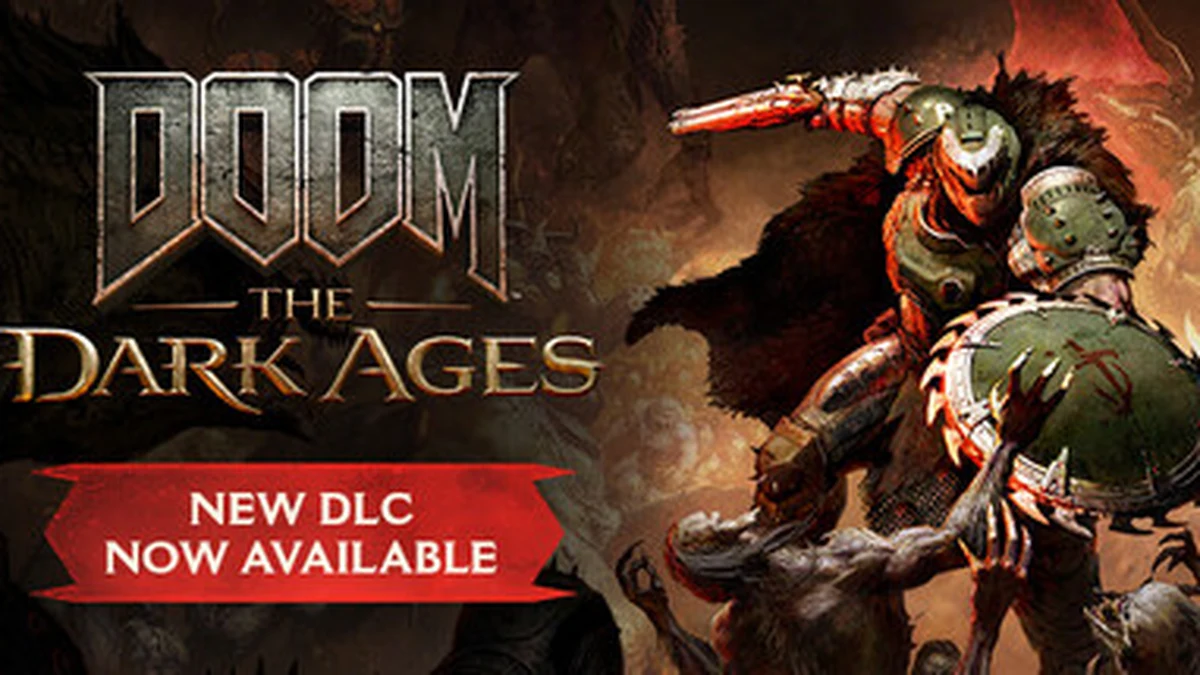
id Software had a genuinely difficult problem to solve with Doom: The Dark Ages. After Doom Eternal turned the series into a hyper-technical, almost rhythm-game-like juggling act of resource management and aerial mobility, where do you go next without simply making “Eternal 2”? The studio’s answer was to go backward in time, both narratively and mechanically, and build a Doomslayer power fantasy around standing your ground instead of running circles around it. The result is a game that feels distinct from its two immediate predecessors, and mostly succeeds at being its own thing, even if it stumbles in a few places Eternal never did.
Story and Setting
The Dark Ages is a prequel, chronicling an earlier chapter of the Doomslayer’s endless war against Hell, framed through a grim, gothic mash-up of medieval iconography and sci-fi hardware. Where past Doom games treated story as barely-there set dressing between gib-fests, this entry leans noticeably harder into cutscenes, lore, and a supporting cast trying to give the conflict some emotional stakes. It’s a gamble that doesn’t fully pay off. The world-building around the Maykrs, the Sentinels, and the Doomslayer’s origins as a weapon is dense and occasionally interesting, but the pacing suffers for it, and the characters delivering exposition rarely earn the screen time they’re given. Nobody plays Doom for the plot, and The Dark Ages doesn’t do enough to change that calculus, though it never derails the moment-to-moment experience either.
Gameplay and Combat
This is where the game earns its keep. The central idea is simple: make the Doomslayer feel unstoppable rather than untouchable. Instead of dashing and double-jumping away from danger, you’re encouraged to walk into it, using the new Shield Saw to block, parry, and throw your way through demon hordes. Parrying is the star of the show — a tightly timed green-flash mechanic that rewards aggression and punishes hesitation, and it makes standing in the middle of a room full of monsters feel like a fair fight rather than a death sentence. The shield can also be thrown like a buzzsaw boomerang, chaining into melee weapons like the flail and mace for some of the most viscerally satisfying kills in the series’ history.
The weapon roster is as inventive as ever, and the game leans into big, chunky, impactful guns rather than Eternal’s precision toolkit. One notable change: The Dark Ages does away with strict weapon-to-enemy weakness pairing, so you’re rarely forced to juggle a mental checklist of which gun beats which demon. That’s a real simplification of Eternal’s systemic depth, and players who loved that game’s puzzle-like combat encounters may find this version less cerebral. In exchange, you get combat that’s more immediate and readable, better suited to the game’s slower, tankier power fantasy.
Where the game falters is in its larger set-piece missions. Sections where you pilot a giant Atlan mech or ride a cybernetic dragon are spectacular the first time and increasingly tedious by the third or fourth. They break the rhythm the shield-and-gun combat builds so well, and by the back half of the campaign, the game’s insistence on returning to these modes starts to feel like padding rather than variety. Levels also grow visually and structurally repetitive as the campaign wears on, with corridors of similar Hell-scapes blurring together in a way the tightly curated Eternal mostly avoided.
Visuals, Sound, and Performance
Visually, this is one of the best-looking shooters of the year. idTech’s engine renders massive, ornate environments — cathedral-sized Hell fortresses, war-torn medieval cityscapes — with a scale and detail that Eternal’s tighter arenas never attempted. The demon and weapon design remains gruesomely inventive, and the sound design, from the crunch of the shield saw to the series’ trademark heavy-metal score, keeps the adrenaline where it needs to be.
Console performance is solid across PS5 and Xbox Series X/S. PC is a more complicated story. The Dark Ages mandates ray tracing with no option to fully disable it, which means players without RT-capable hardware are locked out entirely, and even those with capable cards have reported inconsistent frame pacing and stutter depending on configuration. Combined with system requirements that skew higher than most shooters, this is a game that asks more of your PC than its genre peers typically do.
What Works
The shield-and-parry combat loop is a genuine reinvention of the series’ core fantasy, and it lands. Standing toe-to-toe with a room of demons and walking out unscathed because you read every attack correctly is one of the best feelings in any shooter this year. The weapon variety, art direction, and sheer scale of the environments are all a clear step up in ambition, and the game’s best levels rank with anything id has made.
What Doesn’t
The story indulges itself more than the material supports, the mech and dragon sections wear out their welcome fast, and the late-game campaign leans on repetition rather than escalation. Simplifying enemy weaknesses trades some tactical depth for accessibility, which won’t sit well with everyone. On PC specifically, the forced ray tracing requirement is a real barrier for a meaningful chunk of the potential audience.
Verdict
Doom: The Dark Ages is a confident, often thrilling reinvention of what a Doom campaign can feel like, built around a shield-parry combat system that’s among the best melee-adjacent design in modern shooters. It’s not a clean upgrade over Doom Eternal so much as a sideways move — grounded where Eternal was frantic, more narrative-heavy where Eternal was minimalist — and whether that trade works for you depends on what you valued about the previous games. Fans of tactical, aerial, puzzle-combat Doom may find themselves missing Eternal’s precision. Anyone looking for a bone-crunching, stand-your-ground power fantasy with spectacular set pieces will find plenty to love here, provided they can tolerate a padded back half and, on PC, hardware that can handle mandatory ray tracing. Recommended for genre fans and series veterans; those on a budget or an older PC should wait for a sale.