
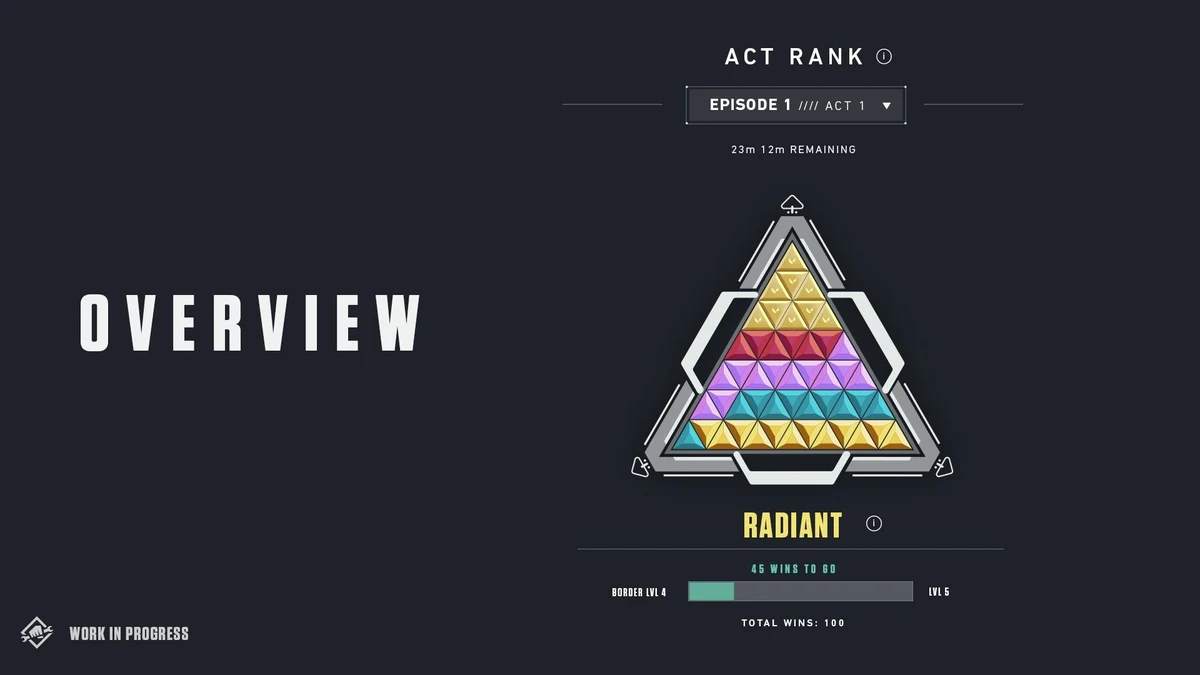
Nothing generates more confusion in Valorant than watching your Rank Rating swing wildly after a single match — or losing a rank after a new Act starts even though you haven’t played a game. The system makes sense once you understand what’s actually driving it. Here’s how Valorant ranks genuinely work as of Season 2026.
The Nine Valorant Ranks
Valorant’s ranked ladder has nine tiers, and every one except the very top is split into three divisions, for 25 total rank steps:
| Rank | Divisions | Rough player share |
|---|---|---|
| Iron | I-III | Entry tier |
| Bronze | I-III | Common |
| Silver | I-III | Most populated single rank |
| Gold | I-III | Common |
| Platinum | I-III | Above average |
| Diamond | I-III | Above average |
| Ascendant | I-III | Competitive |
| Immortal | I-III | Top ~1% |
| Radiant | None | Top 500 players per region |
As of August 2026, Silver is the single most common rank, and over 60% of the entire player base sits somewhere between Bronze and Gold. Roughly another quarter of players occupy the Platinum-to-Ascendant range, while Immortal and Radiant combined make up less than 1% of all ranked players. If you’re wondering how your rank stacks up, that context is genuinely useful — most players are closer to the middle of the ladder than they think.
How RR (Rank Rating) Actually Works
RR is the visible number that determines your progress toward the next rank. You need 100 RR to climb a division, which means 300 RR to climb a full rank tier (three divisions), except from Immortal onward, where RR compounds across divisions instead of resetting at each one.
A typical match is worth somewhere around 20 RR, but the exact amount varies: wins can grant anywhere from roughly 10 to 50 RR, and losses can cost roughly 10 to 30 RR. That range exists because of a second, hidden number working behind the scenes.
RR and MMR Aren’t the Same Thing
Alongside your visible RR, Riot tracks a hidden Matchmaking Rating (MMR) that estimates your true skill level more precisely than your rank alone. The relationship between the two drives how much RR you gain or lose:
- If your MMR is higher than your visible rank, you’ll earn more RR per win and lose less per loss — the system is nudging you toward where it thinks you belong.
- If your MMR is lower than your visible rank, wins earn diminishing RR and losses cost more — you’re effectively being pulled back down toward your true skill level.
This is why two players who go 13-7 in the same match can end up with noticeably different RR gains. It’s not random; it reflects how each player’s hidden MMR compares to their current rank.
Promotion, Demotion, and Rank Rating Shields
Hitting 100 RR in a division promotes you to the next one. Dropping to 0 RR risks demotion, but Riot builds in some protection: every time you rank up (aside from reaching Radiant), you receive a Rank Rating Shield that protects your first two matches at the new rank from an immediate drop, even if you lose both. It’s designed to stop players from yo-yoing back and forth the moment they promote.
Below Immortal, demotion typically requires losing while already at or near 0 RR in your current division. Once you understand this, tilting after a single bad loss makes a lot less sense — one match rarely erases meaningful progress unless you were already on the edge.
How Season 2026 Acts Affect Your Rank
Valorant now runs on a year-long Season structure made up of six two-month Acts (Season 2026 is currently in Act 4, running from late June through August 19, 2026). At the start of a new Act, Riot applies a soft reset to ranked ratings across the board. This compresses inflated ranks back toward the middle of the distribution, so most players see their visible rank drop somewhat and need a handful of games to climb back to roughly where they left off.
This isn’t the same as the old full re-placement system from Valorant’s early years. You won’t need to grind five fresh placement matches every single Act — brand-new accounts still go through the standard 20 unranked matches plus 5 placement matches described in our beginner’s guide, but existing ranked players simply recalibrate over their first few games of the new Act.
Radiant and the Leaderboard
Radiant isn’t tied to a fixed RR number the way other ranks are. Instead, it’s a leaderboard-based rank reserved for the top 500 players per region (North America, EMEA, Brazil, Latin America, Korea, Japan, and Southeast Asia all have their own separate cutoffs). That means the RR required to reach Radiant fluctuates constantly depending on how competitive that region’s top players are at any given moment — there’s no static target to hit.
Ranked, Unrated, and Premier: Where RR Actually Applies
It’s worth being clear that RR only exists in Competitive queue. Unrated matches use the same map pool and round structure but don’t touch your rank at all, which makes them a genuinely useful place to test new agents or warm up without risking a demotion. Premier, Valorant’s team-based league mode, uses its own separate scoring system tied to a squad rather than an individual RR ladder, so climbing in Premier doesn’t affect your solo-queue Competitive rank or vice versa. Spike Rush and other rotating modes don’t interact with RR at all.
This separation matters because it means you can freely experiment in Unrated or Deathmatch without any ranked consequences, then bring what you’ve learned into Competitive once you’re confident. A lot of players skip this step and wonder why their rank stalls — testing a new agent for the first time in a ranked match is rarely the fastest way to climb.
A Quick Example of RR in Motion
Say you’re sitting at Gold 2 with 60 RR. A close win nets you 22 RR, pushing you to 82 RR — still Gold 2, but close to promotion. Your next win is a blowout where you go 20-6 with a big impact; because your hidden MMR is reading higher than Gold 2, that win might grant 30+ RR, promoting you straight to Gold 3. Then say you drop a close loss at 15 RR in Gold 3 — your Rank Rating Shield from the recent promotion protects you from immediate demotion back to Gold 2, even though you’re technically at risk. That’s the system working as intended: rewarding performance relative to your hidden skill level while cushioning the swings right after a promotion.
Frequently Asked Questions
Q: How many placement matches do I need to get ranked? Five placement matches, after first completing 20 unranked matches and reaching Account Level 20. Your results in those five games (wins, losses, and round differential) set your starting rank.
Q: Can my rank go down if I stop playing? Not from inactivity directly, but you will be marked “rank decayed” or unranked-displayed after extended inactivity in some seasons, and Act resets will naturally require you to re-climb a bit regardless of whether you played.
Q: What’s a good rank for an average player? Gold to Platinum is a reasonable midpoint given that well over half the player base sits at or below Gold. Reaching Platinum already puts you ahead of a majority of ranked players.
Q: Why did I lose RR even though I performed well individually? RR is tied to your win or loss, not your personal stats. Strong individual performance in a loss can sometimes soften the RR hit slightly, but it won’t turn a loss into a gain.
Q: Is Immortal the same as being pro-level? No. Immortal represents roughly the top 1% of the ranked player base, which is genuinely skilled, but professional players and Radiant-level players operate well above even Immortal on average.
The Bottom Line
Valorant’s rank system rewards consistency far more than any single big win or bad loss. Understand how RR and MMR interact, don’t panic after an Act reset, and focus on steady improvement instead of chasing a number every match. If you’re still working on the fundamentals that actually move your rank, our complete Valorant guide and our best agents tier list are both solid next stops.